Managing AI-Generated Code Quality in GDScript and C# Game Projects
AI-generated game code passes linting but fails at runtime—here's how to catch it.
AI-generated GDScript and C# fails in a way that standard review tooling structurally cannot see. The code is syntactically valid, passes the linter, and breaks at runtime for reasons that have nothing to do with style. Managing quality in AI-assisted Godot projects means building a review layer tuned to the specific failure modes models actually produce: version drift, missing engine idioms, and context poverty.
Why AI-generated GDScript and C# fails in ways that standard code review does not catch
The defining failure mode is version drift. A model trained heavily on Godot 3 corpus emits yield instead of await, KinematicBody instead of CharacterBody, the old tween API, export instead of @export. Every one of these passes a syntax check. Every model on the current list does this sometimes. Stronger models drift less often, but none drift never.
A second failure mode is specific to GDScript, and it's subtler than deprecated syntax. The public training corpus for GDScript is far narrower than for C# or C++, so models produce code that runs but reads like translated Python. Signals get wired as callbacks through connect() rather than used as first-class awaitable events. @onready is missing from node references set in _ready(). Function signatures lack type hints. Custom Resource classes don't appear where the engine's data model expects them. None of this breaks a single script in isolation. It compounds across every refactor on a multi-file project, because each file the model touches drifts slightly from Godot-native convention.
C# in Godot's.NET build is less prone to version drift, since C# is one of the better-trained languages in frontier models. It is not immune to the third failure mode. That mode is context poverty: a model working in a plain chat window cannot see the scene tree, guesses node names and signal connections, and produces code that is correct in isolation and broken in the actual project. A standard linter catches style and syntax. It does not catch a correct-looking get_node("Player") that points at a node renamed three scenes ago.
How version drift behaves differently in GDScript versus C# and why that changes what you check
GDScript drift is a training corpus problem. Godot 3 code is abundant in public repositories, so models default toward its idioms under ambiguity. The markers to watch are narrow and predictable: signal syntax, tween API calls, exported variable decorators, and the yield/await swap. These four patterns account for the majority of GDScript version drift, which means a reviewer who knows what to look for can scan for them mechanically.
C# drift in Godot is a different animal. It's less about deprecated syntax and more about structural tendencies in how models write C-family code. The study also demonstrated something more useful: targeted, taxonomy-informed feedback reduced static analysis warnings measurably, which means the pattern is predictable enough to correct for.
In a mixed GDScript-plus-C# project, the two drift profiles compound. The GDScript half may use Godot 4 signal idioms correctly while the C# half introduces coupling patterns that make those signals fragile across the language bridge. Neither language's linter sees the inconsistency, because it lives in the contract between two codebases, not in either one. A missing feature is detectable. A broken game is not.
Which models produce the least drift for GDScript and C# in 2026, and what their remaining blind spots are
Model choice is the cheapest quality intervention available, because it reduces the correction burden before any tooling is involved. For GDScript output quality alone, the practical ranking starts with Claude Opus, with GPT a close second and DeepSeek as the value pick. The ordering holds across idiomatic Godot 4.x patterns: signals as first-class events, @onready usage, type-hinted function signatures, and @export decorators. A DeepSeek-generated script and an Opus-generated script on the same task will differ on these axes even when both run correctly.
For mixed GDScript-plus-C# projects, GPT earns the recommendation on language-switching. Gemini leads for whole-project review across both languages, which is a different job than generation and worth keeping separate. The planning step is where quality constraints get established. The execution step benefits less from frontier pricing.
No model choice removes the final blind spot. Every model writes toward a scene structure it imagines rather than the one actually built in the project. It guesses at node names, invents signal connections, and produces code that would work in a plausible Godot project but not necessarily in yours. That gap is structural, not a weakness of any individual model, and it's the problem the integration layer exists to solve.
What each integration layer can and cannot verify, and why that determines what a review layer must cover
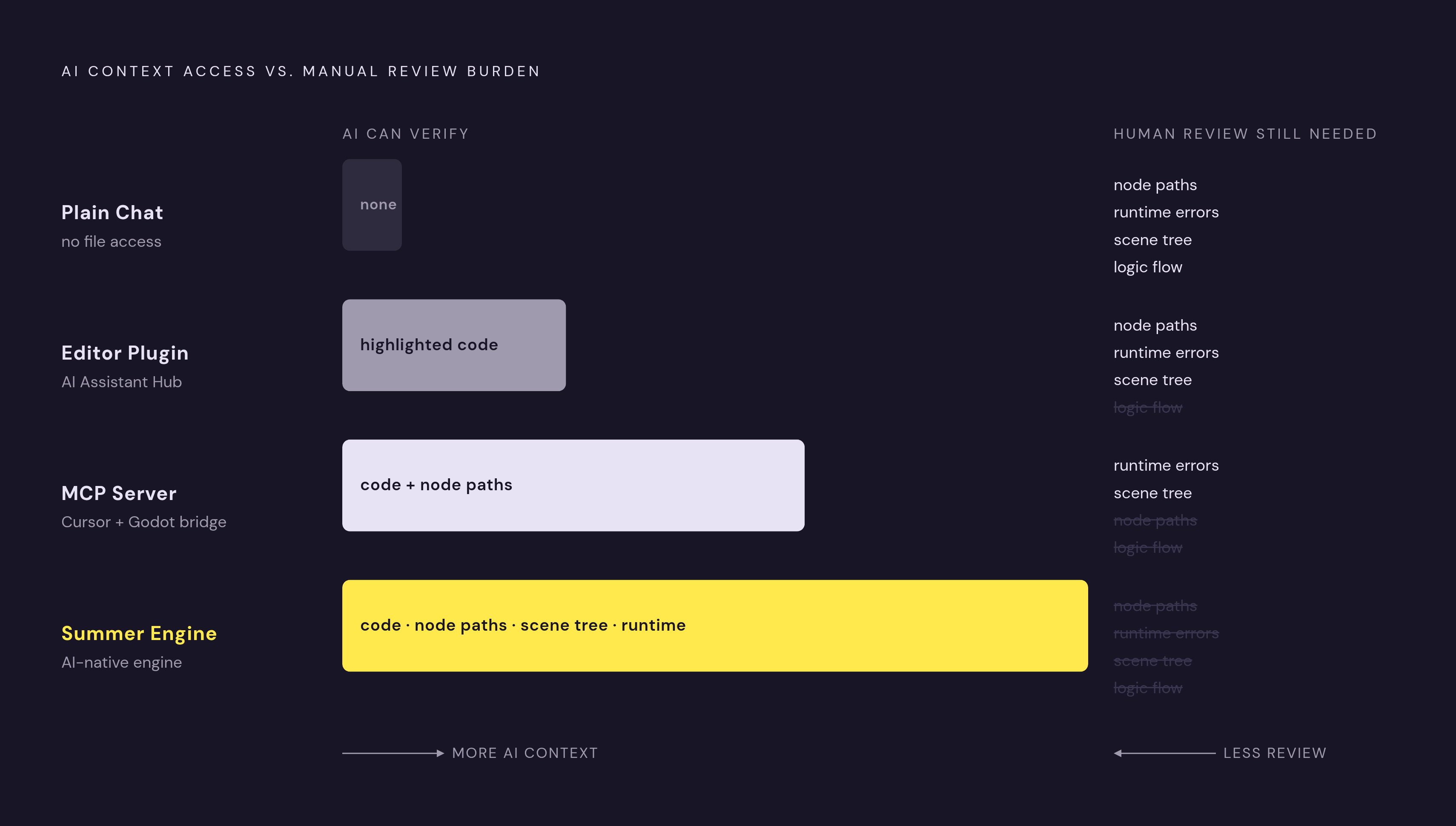
The integration layer determines what the AI can self-correct and what falls through to human review. Plain chat carries verification level of none. Every failure mode lands in the developer's lap: version drift, wrong node paths, missing signal connections. This layer requires the broadest manual review checklist.
MCP servers connecting an external client like Claude Desktop or Cursor to a Godot project change the context picture materially. The remaining gap is runtime. Setup friction is the trade-off: MCP options typically require installing an AI client and configuring a bridge, while plugin-based options require installing a plugin in Godot, and some implementations demand explicit permissions.
Editor plugins, like AI Assistant Hub by FlamxGames, operate inside the Godot editor and read highlighted code, but they cannot watch the game while it runs. There's no press-play-and-read-the-error step. The loop is shorter than plain chat, but it's still a human loop.
Summer Engine sits at the deepest layer of this stack. Because the AI is built into the engine itself, it understands scenes, nodes, scripts, signals, resources, and the game while it runs, which lets it read runtime errors and self-correct in a loop that a code-only chat window structurally cannot. It's one of very few setups in the current field that closes the runtime self-correction loop without developer intervention. The honest limit is that it's a separate application rather than stock Godot, so teams with deep investment in editor-specific plugins or a custom editor build may find an in-editor plugin fits their existing setup with less friction.
The practical implication runs in one direction. The further down the stack the integration sits, the shorter the manual review checklist needs to be. The further up it sits, the broader and more systematic that checklist must be to catch what the tool cannot verify.
Building a review checklist tuned to GDScript and C# failure patterns, not generic code review
The review layer should be organized around the failure modes AI actually produces, not the ones a human developer typically makes. That distinction changes the checklist from a generic code review guide into something narrower and more mechanical. The version drift scan is required at every integration layer. The positive signals are specific enough to scan for by eye or by script: yield where await belongs, KinematicBody where CharacterBody belongs, export without the @, old tween API calls. The reason a linter misses these is precise: the old syntax is valid GDScript that runs on Godot 3. It isn't a syntax error. It's a version error. A linter configured with version awareness for the current Godot release will flag it, but only if that configuration is active. Typed GDScript with explicit types makes some drift patterns detectable by the editor itself before review, which is one reason to require types in any script the AI may touch.
Node path and signal connection verification is required at plain-chat and plugin layers, and partially handled by MCP. The review step traces every get_node(), $ shorthand, and connect() call against the actual scene tree. This check is mechanical enough to script as a pre-commit check against the .tscn files.
The idiomatic GDScript pattern audit applies when the model is below the frontier tier or the task spans multiple files. The patterns: signals used as callbacks via connect() rather than as first-class awaitable events, missing @onready on node references set in _ready(), function signatures without type hints, variables that should carry @export but don't. These are the axes on which models vary most, and they're the patterns that compound across a multi-file project even when each script runs correctly on its own.
The C# coupling and interface review is required for any AI-generated C# in the project. The documented failure profile points to three concrete checks. The production-scale evidence shows this loop works, with warnings dropping measurably when feedback is targeted and taxonomy-informed.
Cross-file consistency review applies to any agentic multi-file edit. When an agent edits several files in one session, naming conventions, signal contracts, and resource paths can diverge silently. The practical rule is that an agent editing many files unsupervised is a liability, not a teammate. Scope agentic tasks to a function, a batch job, or a single scene, and review the diff as a unit rather than file by file.
The runtime check closes the loop at plain-chat and plugin layers. Pressing play is part of the review, not an afterthought. Tools like Summer Engine that embed AI directly into the engine itself can detect version drift and context-poverty failures earlier than external chat interfaces, because the AI sees the actual scene tree, node names, and project structure in real time, eliminating the guessing about signal connections and renamed assets that trips up code generated in isolation.
How to structure feedback to the model so the same failure patterns do not repeat across the project
A review layer that only corrects without feeding findings back leaves the same patterns recurring throughout the project. The feedback loop is what converts review into quality improvement, and the production-scale evidence supports it directly: targeted, taxonomy-informed feedback produced a measurable reduction in static analysis warnings and improved computational efficiency. The same principle applies at game project scale.
The mechanism is concrete. Add a project-level system prompt rule or persistent instruction that explicitly forbids yield and requires await. Repeat for each pattern the checklist catches. For a C# coupling failure, a taxonomy-informed instruction might read: "When writing C# for this project, pass references rather than copying objects, prefer LINQ or standard APIs over explicit loops, and express cross-class dependencies through interfaces." The instruction names the category, not just the instance, which is what lets the model generalize to code it hasn't written yet. Plain-chat workflows require maintaining a standing rules block and pasting it at the start of every session, which is mechanical but works.
Typed GDScript serves double duty here. Requiring explicit types in any script the AI may touch is both a project-quality standard and a drift-reduction measure, because the editor can then catch type mismatches that a dynamic-typing setup would pass silently. The planner-plus-executor pattern serves quality as well as cost: putting a frontier model on the planning side means the plan itself can be reviewed against quality constraints before a single line of code gets written.
Choosing the integration setup that matches your project's quality risk and your team's review capacity
The right integration setup is the one whose residual review gap matches what the team can realistically close, not the most sophisticated setup available. Different team profiles land in different places. A solo developer or time-constrained indie with limited Godot experience faces the largest review burden at the plain-chat or plugin layer, where the version-drift scan and node-path check are non-negotiable. An experienced developer or small studio already living in an external AI client gets real value from the MCP layer with a Godot bridge, which provides project-aware context and eliminates the node-path failure mode. The residual gap is runtime, and the review checklist focuses on the C# coupling audit and cross-file consistency check. Cursor with a Godot MCP server is the strongest pure coding-assistant option for this profile, with the honest limit that it cannot press play and read a runtime error.
Mixed GDScript-plus-C# projects carry the language-switching risk, so the review checklist needs both columns. Model choice matters here, and GPT handles the language bridge most smoothly. The cross-file consistency check becomes more important because GDScript and C# signal contracts can diverge in ways neither language's linter catches alone. Summer Engine maintains backward compatibility while remaining GDScript-aware, so it can flag version-specific idiom mismatches as they occur rather than surfacing them only at runtime, a targeted detection layer that accounts for the corpus-driven drift patterns unique to each language.
The scope rule applies at every level. Scope control is a quality intervention before the code is even written. And the review layer has a limit worth stating plainly. A quality review layer is for the code, not a substitute for the creative judgment that sits around it.
Sources
- The Best AI for Godot Game Development in 2026 (Honest Roundup)
- Best AI Tools for Godot Game Development in 2026 (Tested and Compared)
- The Best AI for GDScript in 2026 (Honest Model and Tool Roundup)
- Characterizing the Quality Profile of AI-Generated C++ in Production
- The Best AI Coding Assistant for Godot in 2026 (Ranked by Real GDScript Work)