MCP Integration Inside a Game Engine Development Environment
Embedding MCP inside the engine lets AI agents see and fix live game state instead of dead files.
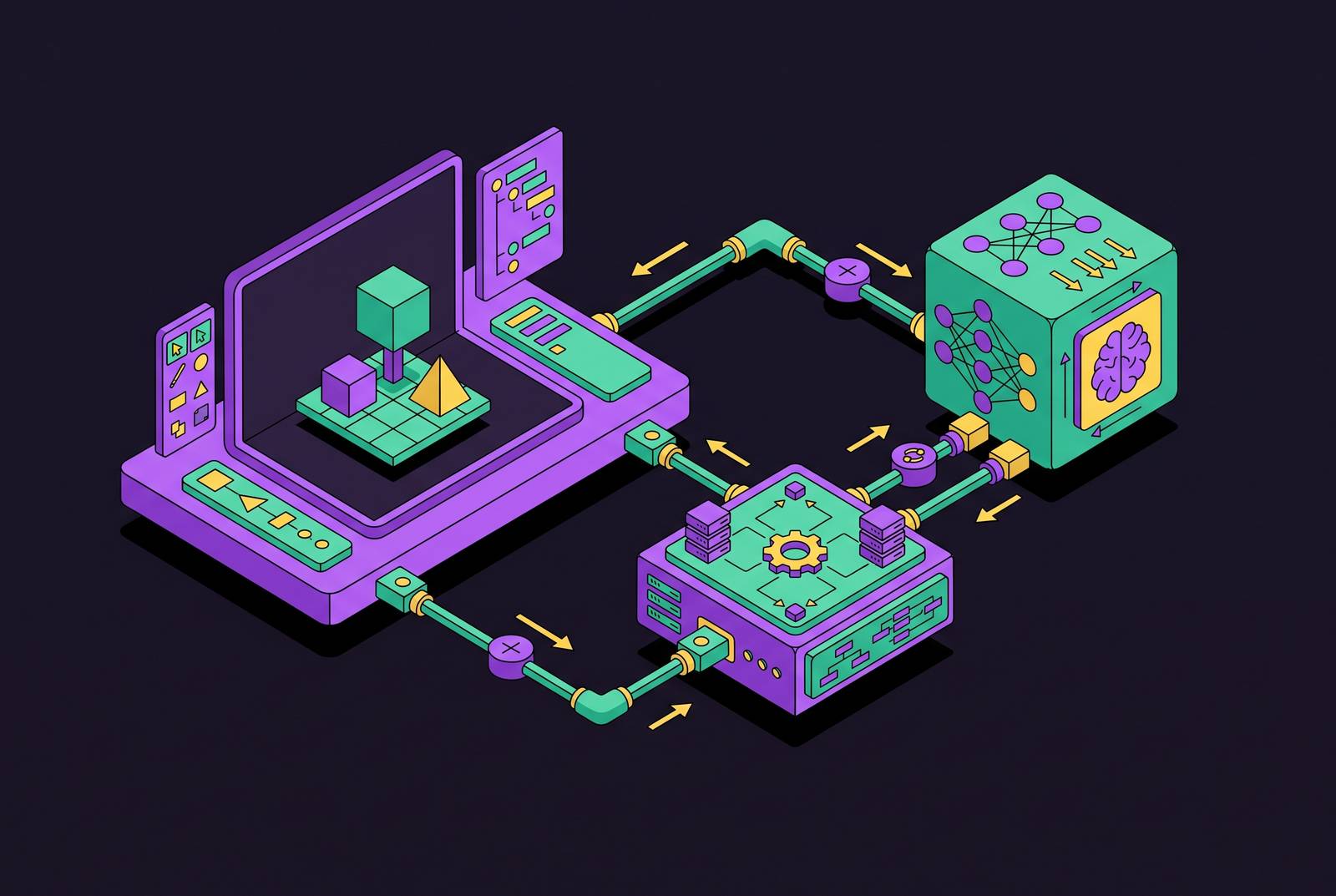
MCP gives an AI agent a standard way to find, pick, and call external tools through plain JSON-RPC messages, and each tool publishes a machine-readable description of what it takes in and what it hands back. Game engines turn out to be an unusually good match for this setup, and placing MCP inside the engine rather than beside it changes what an agent can actually see and do with a live project. This matters because the integration point, not the underlying model, is what decides whether an AI assistant edits dead files or runs and fixes a working game.
What MCP is and why game engines are a natural fit for it
The agent can discover available tools at runtime, so a developer doesn't need to wire a custom API or hand-code a script for every task. Each tool describes its own inputs and outputs, so the agent reasons about what's available and picks the right one for the job in front of it. A rough three-way split sits beneath that discovery mechanism: perception tools that read data, reasoning tools that analyze it, and action tools that change the environment. A game engine already runs on something close to that same split internally: a scene tree to inspect, a debugger to reason with, scripts and assets to change.
That structural overlap is not incidental. A game engine is a compound environment by nature: a scene tree, an asset library, a script runtime, a debugger, and a publishing pipeline all operate as separate but connected systems, which is close to a textbook case for the kind of multi-surface navigation MCP's tool-discovery model was built to handle.
The protocol's governance has also settled into something stable enough to build on. Anthropic gave the MCP specification to the Agentic AI Foundation under the Linux Foundation, and multiple major technology organizations now back it as a vendor-neutral open standard. If you want to build engine-level tooling on top of MCP, this matters: a standard that might fork or fragment under one vendor's control is a weak foundation for something as central as how an agent touches a live project.
Why placement inside the engine changes what an agent can perceive and do
The single variable that determines what an AI agent can do inside a game project is where its MCP connection lives, not how good the underlying model is or how well the developer writes a prompt. An agent whose MCP integration runs inside the engine sees live state: the running scene tree, real-time debugger output, the actual values on an active node, and it can act on that live state directly, without the developer standing in the middle relaying information back and forth.
That gap is most visible at runtime. An agent integrated inside the engine runs the game itself, reads the diagnostic as it happens, and corrects the script against the actual error, not a guess at what the error might be.
Research on SUMO-MCP, a project that wraps a complex simulation tool's core utilities into an MCP-compatible tool suite, offers a useful parallel. The same mechanism, applied to a game engine's play-debug-fix loop, produces a shift in kind. An external MCP server bolted onto a game editor exposes a fixed set of operations from outside the walls. An MCP layer built into the engine can expose the engine's entire internal state as resources and its own systems as action tools. The surface area available to the agent is larger by construction, not by configuration.
A Game Engine's MCP Surface Area in Practice
A serious engine-level MCP integration doesn't collapse everything into one giant "edit project" action. It breaks the engine into distinct callable tools: scene management, script generation and editing, physics and node configuration, audio, UI, animation, and the export pipeline each stand as their own surface. Because of that granularity, an agent can make a precise change, like setting a collision layer on a single node, without touching anything it wasn't asked to touch. An agent limited to rewriting a whole scene file has no such precision, so every edit risks side effects the developer didn't request.
Resources, the read-only layer of this architecture, give an agent context that persists across a conversation instead of forcing it to re-read the whole project on every turn. The agent calls a proven sequence instead of reasoning the whole thing out from nothing each time it's asked.
The early external integrations that have appeared in the gaming MCP server landscape already cover a lot of this ground: scene creation, script editing, node management, 2D and 3D system configuration, animation, audio, and export build settings. A native, internal integration unifies and deepens that same ground. Implementation tends to split along two modes: file-based manipulation, which works without the editor even running and suits batch operations, and live editor integration over a persistent connection, which handles real-time changes and is required for the play-read-fix loop that gives this whole approach its value.
Summer Engine's architecture reflects this design directly. The agent's tools come from inside the engine itself, so a natural-language command reaches the scene tree, the asset library, and the publishing pipeline through one persistent context.
The workflows external MCP setups cannot replicate
A number of genuinely valuable game-development workflows are closed off to external MCP setups for a structural reason: they need the agent to hold live engine state in its working context while acting on that same state, and only an internal integration meets that condition.
The clearest case is the runtime debug loop. An external assistant can only work against the state of the project from before anyone pressed play.
Scene-aware asset placement runs into the same wall. A tool working off saved files is working off a snapshot that may already be out of date by the time it acts.
Signal wiring shows the problem in miniature. If an agent holds internal context, it keeps that chain intact across all three steps. An agent working externally has to re-read the project state between each one, and that invites drift and error.
Publishing is the same story at a larger scale. Triggering a platform-specific export, checking that it succeeded, and reporting any errors back into the same conversation all require an agent that spans both the engine's internal export system and the result that export produces. External integrations tend to treat those as two separate, disconnected operations.
The SUMO-MCP comparison applies again here. What distinguished that platform from earlier, more rigid integrations was its ability to combine exposed tools freely, without extra coding, for flexible custom workflows, rather than forcing users through fixed and predefined steps. That exact distinction is what separates an internal engine MCP layer from an external assistant that edits files.
Where external MCP setups and coding assistants remain strong
None of this means external tools are a lesser choice for every developer. For pure code quality, fast inline autocomplete, and confident refactors across many files at once, a strong external coding assistant paired with a Godot MCP server is a legitimate, often excellent choice for developers who want IDE-level control.
For a developer with years of established habits in one tool, that lower switching cost is a real advantage, not a minor convenience.
The sharpest technical friction for any AI assistant working in Godot 4.x is version drift. The fix is the same regardless of which tool is doing the generating: state the Godot version explicitly in every prompt. Integration placement doesn't solve this on its own. An agent running inside the engine with a weak underlying model will still produce 3.x patterns, because GDScript accuracy and integration depth are two separate variables. The real gains appear only when both are strong at once.
The honest way to put the split: external assistants are strongest at the language layer, syntax, API accuracy, refactoring cleanly across many files. Internal integration is strongest at the runtime layer, playing the game, reading what actually happens, correcting it, and doing that again. These are two different halves of the same problem, and a developer who understands the split can pick tools deliberately.
The wider pattern in how agent tools are used backs this up. Developers are shifting from using AI to read and suggest to using it to act. How much of that action capability actually reaches a game engine depends on the integration architecture you choose.
Security and observability considerations when an agent can act inside a live engine
When an agent can modify scene trees, run scripts, and trigger exports directly, it also creates a new action surface, one that ordinary file-monitoring tools were never built to watch closely.
Enterprise security research on MCP-driven agents names the core gap: endpoint detection tools can see a file write or an API call happen, but they can't see why the agent did it. The prompt that caused the action, the reasoning steps the agent took, and the chain connecting intent to execution stay invisible to conventional monitoring, which only ever sees the output, not the cause.
Inside a game engine, the stakes are narrower than in an enterprise financial system, but they still matter. An agent that misbehaves, or is fed a bad instruction, could overwrite a scene file, delete an asset, or trigger an export nobody wanted. Content hidden inside a project file or buried in asset metadata could instruct the agent to take an action the developer never asked for, the moment the agent reads that file as part of some unrelated task.
The mitigations that matter are not exotic. An engine built around MCP from the ground up should put these confirmation gates in plain view in its interface rather than hiding them behind the scenes, because showing a developer what the agent is about to do is both a safety measure and the thing that earns trust in the tool over time.
What this integration model means for non-technical creators specifically
The value of internal MCP integration isn't distributed evenly across users. For an experienced developer, it compresses the time between writing something and knowing whether it works. For a creator without a technical background, it removes the requirement to understand the engine's internal model at all in order to direct it.
An external coding assistant still asks something of its user: read the code it generates, spot the error, copy the error message, and prompt again. That loop assumes enough technical literacy to navigate the engine's interface and make sense of what a compiler is complaining about. An agent integrated inside the engine that runs the game itself and corrects its own mistakes removes a person from that diagnostic loop for the most common kinds of runtime failure. The creator describes what should happen, and the agent keeps iterating until it does.
Summer Engine's generative asset studio shows this in a concrete form: it exposes discrete, scoped tools for generating models, audio, music, video, and dialogue as separate callable resources inside the engine, so a developer can ask for one specific asset through conversation.
Game jams are a decent stress test for this whole idea. The constraint, a working game loop built under real time pressure, is exactly the scenario where the full arc of internal integration, scene setup, scripting, asset placement, export, gets tested against conditions that don't forgive a broken loop. It's also where an agent that only edits files and an agent that actually runs and fixes the game diverge most clearly. Summer Engine's own design, an in-engine agent paired with the Summer Studio asset tools, multiplayer deployment, and a publishing path to Summer Games, Steam, and itch.io (with mobile export requiring external platform toolchains), all inside one desktop application, puts this principle into practice directly: the natural-language interface spans the whole arc, so a composer, a QA engineer, or an indie developer with a day job can ship a real game they actually own and can export, without stitching together a stack of separate tools to get there.
The practical standard an integrated MCP engine should meet
Calling something "integrated" doesn't make it so. A lot of tools use the word without having built the write-play-read loop, the context that persists across systems, and the human confirmation step that together make internal MCP integration real. Developers evaluating tools deserve a concrete way to tell the difference.
Start with the live runtime loop: can the agent start a play session, read what the debugger reports, correct the script, and restart, all without the developer manually copying error text between windows? Look closely at tool granularity too: are the MCP tools exposed as discrete, scoped actions, setting one node's property, wiring one signal, or are they coarse, file-level operations that rewrite an entire scene file at a time? So you can tell how precise and how recoverable every change an agent makes actually is.
Last, and most telling: does the workflow end in a game the developer actually owns, can export, and can publish to real platforms, or does it stop at a browser demo that never leaves the environment it was built in? That's the line between a prototype and an actual game engine. Internal MCP integration only means something if it serves a complete pipeline from the first prompt to a shipped, ownable game, not a layer of convenience bolted onto a dead end.