Game Engines That Export to Steam Without a Pro License
Godot, Unity, and GameMaker each let you ship free to Steam, but watch for hidden costs.
"Free to use" and "free to ship commercially on Steam" sound like the same promise, but they are different conditions, and different engines satisfy them in different ways. A developer who downloads an engine, builds for six months, and only then reads the licensing terms in full is taking on real risk, because the gap between those two conditions is exactly where most of the expensive surprises live.
Three traps appear repeatedly across these engines. The first is a revenue cap that triggers once a game crosses a set earnings threshold, forcing a switch to a paid tier mid-development or, worse, mid-success. The second is a royalty on gross revenue above a ceiling, which behaves less like a subscription and more like a silent partner taking a cut once the numbers get large enough to matter. The third is a platform-specific export gate: desktop builds are free, but console or mobile export requires an upgrade the developer didn't budget for.
Steam adds one more wrinkle. Valve's own Steamworks SDK carries no fee, so whatever cost exists at the point of shipping to Steam comes entirely from the engine's own licensing terms, not from the storefront. That means the entire question of "can I ship this to Steam for free" collapses into a single variable: what does the engine actually charge, and under what conditions? Getting that wrong doesn't just cost money. It can force a mid-project migration, which costs months a small team rarely has to spare.
Godot: the engine where "no strings attached" is true
Among the options examined here, one engine answers the licensing question with the fewest caveats. There is no ceiling to plan around and no upgrade notice waiting in a future inbox. Development is backed by the Godot Foundation, and its sponsor list includes JetBrains at the platinum tier, which gives the project financial footing beyond goodwill alone.
The growth numbers back up the licensing story rather than just decorating it. The project has accumulated tens of thousands of GitHub stars as of 2026, the number of Godot titles appearing on Steam roughly doubled year over year, and its share of entries in the GMTK Game Jam, a widely watched bellwether for where hobbyist and indie developers are experimenting, also roughly doubled. A notable share of all Steam releases in 2024 were built with it, which is a meaningful foothold for an engine that charges nothing at any stage.
Some of that momentum has a specific origin point. When a rival engine's runtime fee controversy hit in 2023, developers responded with what got called the "Great Migration," which accelerated developer trust in Godot specifically because of the licensing contrast. Trust, once broken by a licensing change, tends to migrate toward whichever competitor can credibly promise it won't happen again.
On the technical side, the 4.6 release brought a multi-backend renderer, with Direct3D 12 now the default on Windows alongside Vulkan, and kept the node-based scene system that has become the engine's signature. The editor itself is a lean roughly 50 MB install. None of this makes the case that the engine rivals the heaviest 3D powerhouses on raw fidelity, and it shouldn't try to. Its reputation is strongest in 2D and mid-market 3D, and that honest positioning is part of why so many solo developers trust it.
The proof isn't only architectural. Buckshot Roulette, built by solo developer Mike Klubnika, reached 8 million sales within a year of launch, and titles like Brotato, Dome Keeper, and Cassette Beasts are confirmed to run on the same engine. Those are not niche curiosities; they are commercial hits shipped under a license with no revenue ceiling anywhere in sight. Fittingly, the 2025 Community Poll found that most of the engine's users work solo, which suggests the free-forever model isn't an accident of licensing philosophy so much as a deliberate fit for exactly the audience least equipped to absorb a surprise fee. Under the MIT license, the full engine (including Steam export) is free at any revenue level, with no royalties, no revenue thresholds, no subscriptions, and no feature gating.
Unity Personal: free export to Steam, but the revenue cap changes the math
A separate major engine also qualifies as free to ship on Steam, though the arithmetic changes once a project starts making money. The runtime fee was permanently canceled in September 2024, and the Personal plan is currently free to use. For most indie developers, that's the whole story, and it's a genuinely good one.
The condition that matters is a $200,000 revenue or funding cap. Crossing it forces the developer to move to a paid tier. Per-seat Pro and Enterprise subscriptions apply as of January 1, 2025, with Unity Pro now running $2,310 per year per seat. That's not a punishment, though; it's a threshold that only becomes relevant once a studio has already succeeded past six figures in revenue or outside funding, which is precisely the kind of success most developers would be thrilled to have.
Scale tells its own story here. This engine still accounts for the largest raw count of any single engine among new Steam releases in 2026, even though that count is down from a peak share back in 2023. The installed base, not any licensing advantage, explains the number: the developer community around it is the largest of any engine covered in this comparison, and the practical benefits, deep asset stores, endless tutorials, and a labor market full of people who already know the tool, are real and shouldn't be dismissed.
Still, something has shifted in developer sentiment. The 2026 GDC State of the Game Industry survey found a rival engine now ahead of it among developers naming a single primary engine, a reversal from years of prior dominance. That kind of swing doesn't happen because of raw feature comparisons; it happens because developers are reading licensing terms more carefully than they used to, and weighing revenue caps and royalty structures as seriously as they weigh rendering quality.
GameMaker's shift from subscription to one-time license
On 21 November 2023, GameMaker announced it would be "free for non-commercial use on all platforms (excluding console)" and replaced the subscription system with a one-time license. That's a meaningfully different structure from either a royalty or a revenue cap: pay once, and the meter never runs again for that tier.
The current stable build is GameMaker LTS 2026.0, published 21 May 2026, and the platform list is broad: Windows, macOS, Ubuntu, HTML5, Android, iOS, Amazon Fire TV, Android TV, PlayStation 4, PlayStation 5, Xbox One, Xbox Series X/S, Nintendo Switch, and Nintendo Switch 2, though console export specifically requires stepping up to an Enterprise license. For Steam-focused developers targeting desktop, the commercial one-time license runs at approximately $99.99c25, though anyone budgeting around that figure should confirm current pricing directly rather than treating it as permanently fixed, since this is an engine whose pricing structure has already changed once in recent memory.
Scripting runs through GML, a dynamically typed language often compared to JavaScript or other C-like syntax; it's a gentler slope than C++ but still genuine code, and simpler projects can lean on the built-in drag-and-drop visual logic instead. The engine's real strength, though, is 2D. It was built from the ground up for sprite-based games, with native support for raster and vector graphics and 2D skeletal animation through Spine. It is not a 3D engine in any meaningful sense, and developers with 3D ambitions should look elsewhere; that's not a knock, just an honest description of where the tool excels.
The engine's browser platform is phasing out its paid-game purchasing system as of September 2026, with no announced closure of the platform itself. It's context, not the headline, for anyone whose plan is Steam rather than browser distribution.
S&box: the newest engine on this list with the most unusual path to free Steam export
The newest entrant here officially released on April 28, 2026, built on the Source 2 engine with a C# scripting layer, with the S&box layer itself MIT-licensed even though the underlying Source 2 code stays proprietary. What makes it worth including in a piece about free Steam export is a licensing agreement. It's a licensing agreement.
In late March 2026, its developer secured a major deal directly with Valve. That agreement lets creators export projects straight from the editor and publish them as standalone games on Steam entirely royalty-free. No other engine in this comparison has a direct, named partnership with Valve that explicitly covers standalone Steam publishing, which makes this a genuinely distinct path to the same destination every other engine here is also trying to reach.
The feature set is competitive on paper, including a scene system comparable to other modern engines, a hotload system that applies code changes without a restart, an ActionGraph tool for visual scripting, a ShaderGraph, built-in multiplayer, cloud-based asset drag-and-drop, and VR support. Cross-platform reach is still filling in. A Linux beta for compiled builds began in late August 2026 and reached the public on Steam in early September 2026.
None of that erases the fact that this is a brand-new tool. User reviews posted on Steam shortly after its April 28, 2026 release were reported as "mixed" by gaming sources, and the engine is new, with its toolchain and community resources proportionally immature. That's not a disqualifying flaw, just an honest maturity gap. Developers comfortable being early adopters, willing to hit rough edges in exchange for a genuinely novel licensing arrangement, have real reason to watch this space closely. Developers who need a stable, well-documented pipeline today have reason to wait.
GDevelop and O3DE: two more engines where commercial Steam export costs nothing
Two more engines round out the list of options that let developers ship to Steam commercially without paying anything into the engine itself, and skipping them would understate how many legitimate free paths actually exist.
O3DE targets 3D at a scope closer to Unreal than to Godot or GameMaker: modular, AAA-scale architecture, but with an open license. That scope comes with a real cost in learning curve, and its community and surrounding ecosystem are smaller than the more established names in this comparison. Anyone considering it for a Steam launch should look closely at the current state of its export pipeline before committing, since its maturity on that front isn't something this piece can vouch for from the outside.
A separate no-code, event-based engine in this category asks nothing of the developer in terms of programming knowledge at all, leaning entirely on visual event logic rather than any scripting layer. That accessibility is a real strength for the least technical creators in this whole comparison, but it comes bundled with real ceilings on complexity once a project grows past what visual events alone can comfortably express. O3DE (Open 3D Engine), the successor to Amazon Lumberyard, is backed by the Linux Foundation and is open-source, requiring no royalty or pro license.
What the fine print gates, engine by engine
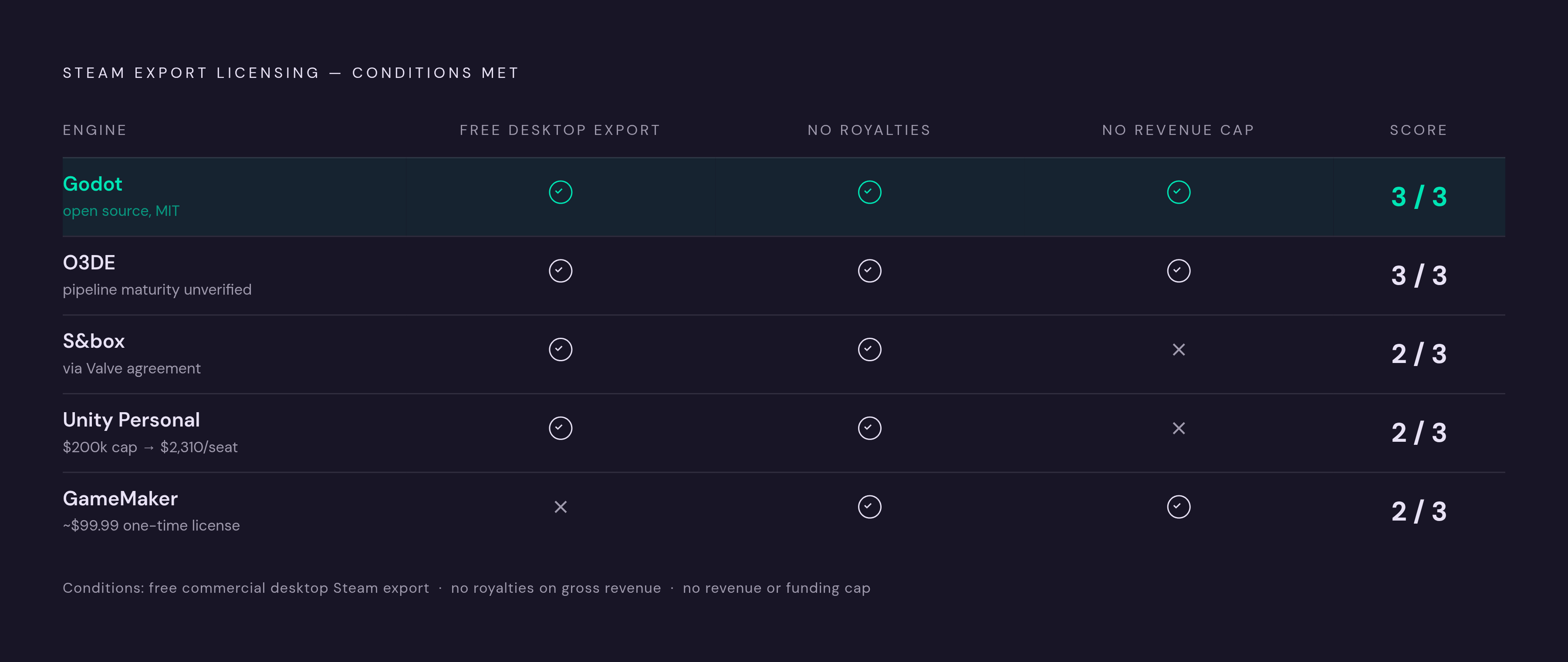
Cutting through all the marketing language, three questions actually decide whether an engine qualifies as free to ship on Steam: is commercial desktop export free at any revenue level, are there royalties charged on gross revenue once a game earns past some ceiling, and is there a revenue or funding cap that forces an upgrade regardless of royalties?
Running the engines covered here against those three questions produces a clean scorecard. Godot is free at any revenue, with no royalties and no cap, the only engine here that passes all three cleanly. The free entry-level tier from the larger engine passes on export and royalties but carries that $200,000 revenue or funding cap before a paid tier becomes mandatory. GameMaker requires a one-time license purchase for commercial desktop export, but once purchased, there are no ongoing royalties or revenue cap, though console export requires Enterprise. The newest engine offers royalty-free Steam export specifically through its Valve licensing agreement, though its terms are new enough that developers should read them closely rather than assume permanence. O3DE carries no royalties or pro license requirement, with the caveat that its Steam export pipeline maturity should be independently verified.
One well-known industry-standard engine misses this list. It charges a 5% royalty on lifetime gross revenue above a per-title threshold, which disqualifies it from the "free to ship" category this piece is mapping, regardless of how capable it is on other merits.
Console export deserves its own line, because it doesn't track neatly with desktop terms. The console export exception applies to GameMaker, which requires Enterprise, and GDevelop, which has a limited 3D/console pipeline. Anyone planning a Switch or PlayStation release on top of a Steam launch needs to treat that as a separate line item in the budget, not an extension of whatever the desktop terms already say.
Engine choice and AI tools in the development workflow
Licensing is the entry condition for shipping to Steam, but it's no longer the only variable that separates these engines in practice. Which AI coding assistants and asset-generation tools plug cleanly into a given engine has become part of the real cost of building a game in 2026, and that ecosystem is not distributed evenly.
Godot's ecosystem has the most developed AI tooling of any engine on this list as of mid-2026. A tool called Godot AI, launched in April 2026, connects several AI coding assistants and other MCP clients directly to a live editor session, covering 46 tools and more than 120 operations across scenes, scripts, signals, UI, materials, animation, and environments, entirely free and open-source. Inside the editor itself, Ziva generates GDScript and C# code and reads debugger errors, GameDev Assistant offers a beginner-oriented tutor mode, and the AI Assistant Hub, an MIT-licensed plugin submitted September 1, 2026, bridges Godot to Ollama, Gemini, OpenRouter, and others. Outside the editor, Cursor with a Godot MCP server, GitHub Copilot, and Claude Code are used, and on GameDevBench Godot 4 tasks (333 tasks), GPT-6 Astra in Codex scored 68.8% and Claude Fable 5 in Claude Code scored 67.3%.
That said, the tooling comes with a specific, practical trap. The engine's current major version changed its own classes and keywords significantly from the version before it, and AI models trained on older material routinely output outdated syntax, referencing classes and functions that no longer exist, inside projects built on the newer version. The fix is procedural rather than magical: specify the exact engine version in the project's instructions to any AI assistant, and validate generated code with headless script checking before trusting it.
The larger engine's bigger community means more training data and a deeper well of tutorials for any AI model to draw from, but its AI tooling ecosystem is comparatively less open, and MCP integration lags the more open alternative as of mid-2026. The newest engine on this list uses a standard C# scripting layer, so general-purpose C# coding assistants apply out of the box, though engine-specific MCP tooling is still nascent given how recently the engine launched. The broader pattern is that an open architecture and a permissive license widen the surface area available for these integrations to plug into, letting AI tools read a live runtime, catch and fix their own errors, and generate assets directly inside the workflow. None of the current asset-generation tools for 3D models, 2D art, or audio are exclusive to any single engine, but an open, unlocked import pipeline makes plugging them in considerably less friction-filled than a closed one.
Matching engine to creator: which free-to-ship option fits which situation
None of this adds up to a single "best" answer, because the right engine depends on what's being built and by whom. A solo developer building a 2D game with no coding background at all gains the most from a no-code, event-based tool, while a solo developer comfortable writing code and wanting the cleanest possible licensing terms, with 3D ambitions kept modest, has the strongest case for the MIT-licensed engine that passes every test in this piece without qualification.
A small team already fluent in a widely taught language, with 3D as a core requirement and a hiring pipeline to think about, has real reasons to stay with the larger engine's free tier, as long as the $200,000 cap is tracked deliberately rather than discovered by accident.
And for a developer drawn to a direct Valve partnership and comfortable being early into a still-forming ecosystem, the newest engine on this list offers something none of the others do, even if it asks for patience most established teams can't currently spare. Honestly, "free to ship on Steam" is no longer a rare condition to search for. The differences between them now matter more than whether any one of them charges a fee at all, since those differences determine which engine actually fits a given project.
Sources
- GameMaker
- Unity (game engine)
- Best Game Engines for Indie Devs: $99 vs $2,310 [2026]
- 7 Best Game Engines for Indie Developers in 2026
- Steam (service)
- Godot 4.6 Arrives With Major CG-Friendly Updates | DIGITAL PRODUCTION
- Godot (game engine)
- Facepunch signed a license with Valve to allow standalone releases from s&box | GamingOnLinux