Game Engines With Built-In Multiplayer for Small Teams
Small teams fail at multiplayer because they pick the wrong engine first.
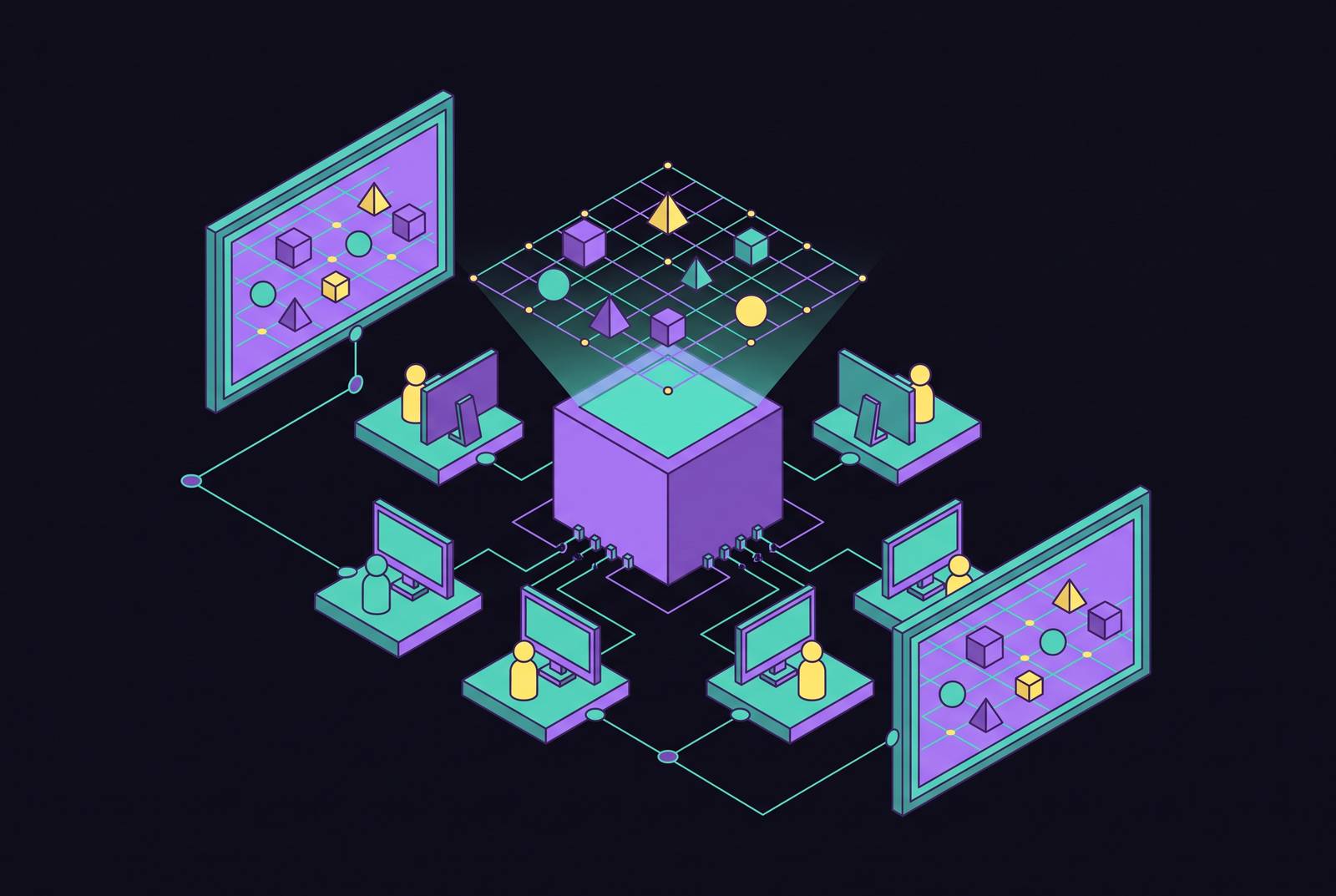
When small teams try multiplayer games, they fail at synchronization infrastructure, not at game design, and the engine they picked at the outset is usually why. A 2025 survey of 500 indie game studios found that over 60% of small teams ran into performance bottlenecks or networking trouble tied to improper engine selection, and a significant share also said their engine lacked multiplayer synchronization tools, which caused development delays. The pattern follows from what multiplayer actually demands: real-time synchronization, matchmaking, and server-client communication all have to work before a single match can run, and a team whose engine provides none of that out of the box has to build it from scratch while a deadline closes in. Lag spikes, desynchronized game states, and poor server scalability are the predictable output of missing infrastructure, not evidence that the team's code was sloppy. Small teams often spread one person across programming, design, and network management at once, and an engine that fails to cut down networking complexity turns that one person into the bottleneck for the whole project. The fix is at the level of engineering selection, not effort or morale: choose an engine whose built-in stack actually covers the hard parts, and the bottleneck shrinks before a single gameplay system gets written.
What "built-in multiplayer" means as a technical checklist
"Built-in multiplayer" names a bundle of separate systems, and a team needs to check each one on its own rather than trust the label as a whole. The first piece is the transport layer: how data actually moves between peers, over UDP, TCP, WebSocket, or WebRTC, and whether the engine handles reliable delivery, packet sequencing, and bandwidth management without pulling in outside middleware. The second is state replication, the mechanism that keeps game objects in sync across every connected client, including players who join a match already in progress, and late-join handling tends to be the edge case that trips up most frameworks first. The third is the event and RPC system, which covers one-off actions like dealing damage, triggering a cutscene, or opening a door, sent reliably between peers without forcing the team to build a custom message bus from the ground up. The fourth is matchmaking and backend services, accounts, lobbies, and leaderboards, which usually live outside the engine proper but still need a documented, supported path into it. The fifth is reconnection handling, what happens when a player drops and comes back; some engines hand that player a brand-new peer ID on reconnect. The team then has to build session persistence on its own, and that work is rarely spelled out anywhere until a team runs into it. A developer can run any engine's marketing claims against these five points before writing a single line of production code, and the comparison that follows uses exactly this checklist.
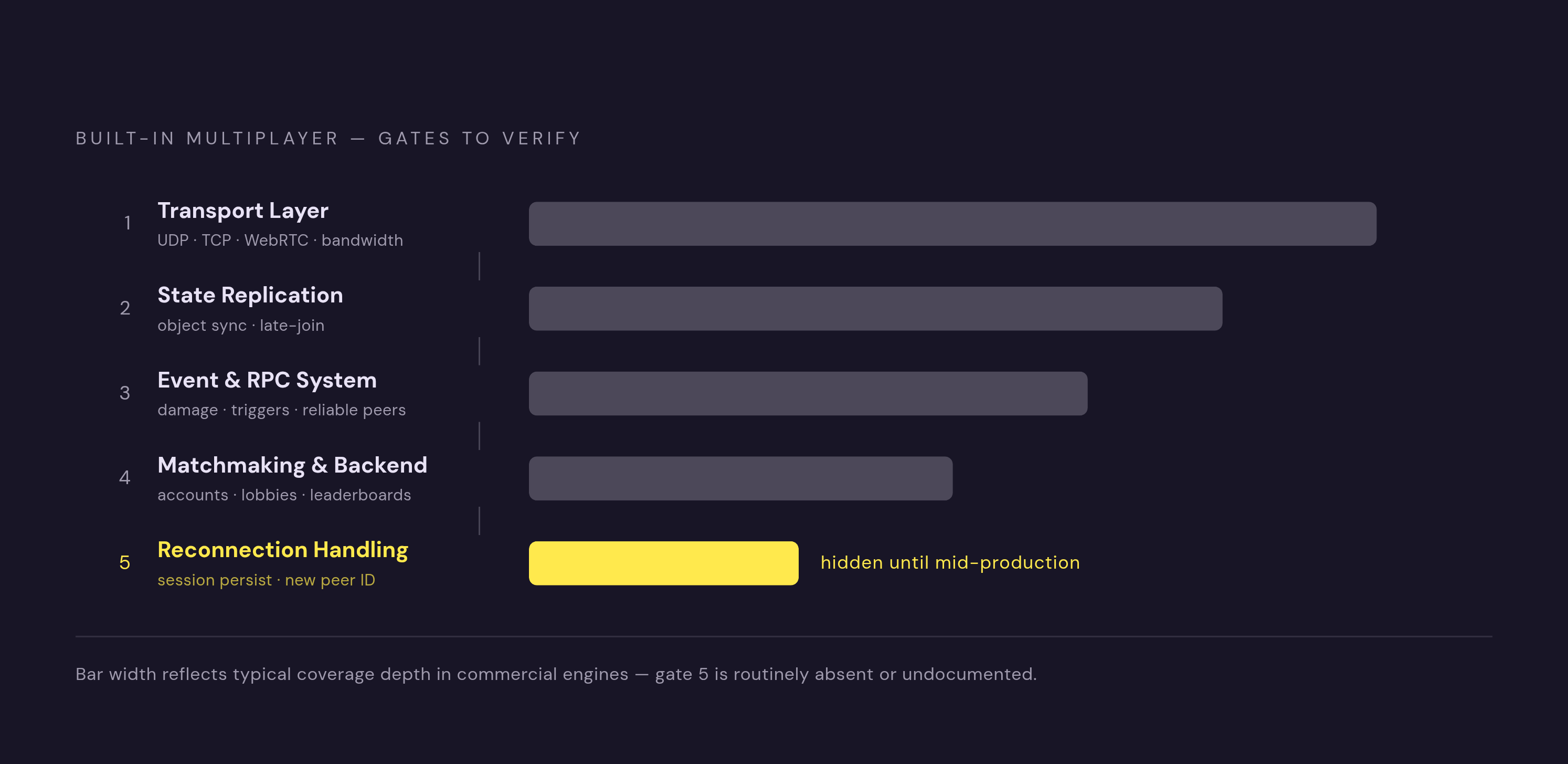
A free, open-source engine's networking stack against the checklist
A community-driven, MIT-licensed engine can cover most of this checklist on its own, and its gaps turn out to be specific and knowable in advance rather than something a team discovers halfway through production. On the transport layer, ENetMultiplayerPeer gives a UDP-based implementation with reliable delivery, packet sequencing, and bandwidth management built in, and WebSocket and WebRTC sit alongside it as options for browser targets. On state replication, MultiplayerSynchronizer streams continuous state such as position, while MultiplayerSpawner watches a designated spawn path in the scene tree and automatically replicates any node created there to every connected peer, including clients who join mid-game; that automatic replication is what makes a late join work without custom sync code. On the RPC system, functions decorated with @rpc handle one-off events like dealing damage, and because the pattern follows the same shape GDScript already uses elsewhere, a team doesn't have to learn much to use it. The one clear, documented gap is reconnection: the ENet implementation has no built-in reconnection logic, a dropped player comes back with a new peer ID, and the team has to build session persistence itself. On the backend side, Nakama, an open-source game backend with an official GDScript SDK, adds accounts, matchmaking, and leaderboards as an autoload, and Heroic Labs' NakamaMultiplayerBridge routes the engine's High-Level Multiplayer API calls over a realtime Nakama match, which keeps the familiar RPC workflow intact even once the messages are traveling through a server. The license carries no royalty obligation and leaves full source ownership with the team, so it removes the kind of licensing risk that can threaten a small studio's business model partway through a project.
Trade-offs of more powerful networking for small teams
Engines built around the most advanced networking feature sets, things like built-in client-side prediction, network relevancy culling, and full replay systems, carry real costs in hardware demand, learning curve, and overall project weight, and for most small teams those costs outweigh the benefit unless the game is a competitive, real-time shooter. These feature sets offer movement prediction out of the box, a relevancy system that culls updates for objects a given player doesn't need to see, and complete replay tooling, and a lighter open-source stack can only reach these through manual work or third-party addons. The cost of getting there is concrete: heavier hardware requirements, a steeper learning curve, and weaker fit for 2D or lightweight mobile titles are three constraints that land squarely on the small-team profile described at the start of this piece. O3DE (Open 3D Engine), the successor to Amazon Lumberyard, is particularly relevant for enterprise-grade simulations and cloud-integrated games requiring AWS-native infrastructure; it isn't a mainstream indie pick, but it's the right answer for large-scale multiplayer with cloud backend requirements. The decision rule here stays simple: a game that doesn't require client-side prediction, turn-based titles, cooperative games, most 2D genres, gets nothing from that networking overhead except added cost.
AI tooling ecosystem as a multiplayer productivity factor
The variable that matters most for engine choice in 2026 isn't raw networking feature count; it's how much of the implementation gap an engine's AI tooling ecosystem can close for a team too small to staff a dedicated network engineer. AI coding assistants have moved past autocomplete and into full development loops, so when a team evaluates engines, it shouldn't ask which one has the best raw networking, but which engine's AI ecosystem closes the most of the implementation bottleneck a solo developer or small team actually faces. Three distinct kinds of AI integration have formed around the open-source ecosystem described above. Editor plugins sit at one end: the Godot AI Assistant Hub, free and open-source, built by FlamxGames, embeds chat assistants directly in the Code Editor, reads highlighted code, and writes GDScript back using whichever LLM the developer already runs, through Ollama, Gemini, xAI, OpenRouter, and similar providers, though it only works at the level of selected code and can't see the live scene tree or read the debugger while the game runs. MCP servers go further: the Godot MCP project exposes the scene tree, node properties, and a GDScript execution channel over a local WebSocket, letting an AI IDE translate tool calls into those messages to build scenes, manipulate nodes, run GDScript inside a live game, record input, set up physics, author animation, export the project, manage addons, debug, and capture screenshots. Agentic skills frameworks go further still: GodotPrompter, MIT-licensed, gives AI coding agents domain-specific expertise across GDScript and C# projects, spanning project setup, architecture, gameplay systems, input handling, physics, 2D and 3D systems, animation, shaders, audio, UI, multiplayer, localization, procedural generation, XR and VR, native extensions, multithreading, mobile shipping, optimization, language-specific patterns, and third-party addons. Model choice affects how much of this actually works in practice: Claude Opus stands out as the most reliable model for GDScript as of mid-2026, producing clean, idiomatic code, handling await and signals correctly, and drifting least into deprecated patterns, and it also holds up well on multi-step agentic work, the kind of chained task where an AI has to create a node, write its script, connect a signal, and run it across a multiplayer synchronization feature. AI assistance still slips on deprecated engine APIs from older versions, the exact signal connection syntax a given node needs, and physics layer setup, and these happen to be the exact engine-specific gotchas that bite teams building reconnection logic or backend integration. A documented gap like missing session persistence on reconnect gets less daunting once an AI tooling ecosystem can scaffold a chunk of the solution, but the team still has to understand what it's being asked to fill in behind the scaffold.
Applying the checklist: a decision framework for small teams choosing an engine for a multiplayer project
Choosing an engine for a multiplayer project comes down to matching constraints, and the best outcome for a small team starts by eliminating whatever fails its hardest constraint, then optimizing within whatever survives that cut. If a team has zero networking engineers on staff, it should start by removing any engine whose built-in stack doesn't cover state replication and RPC, because tutorials alone won't close that gap. Genre sets the ceiling on how much networking power the project actually needs: turn-based, cooperative, puzzle, or narrative multiplayer runs fine on a lighter open-source stack, and client-side prediction adds scope without adding anything the game needs; competitive real-time genres like shooters, fighting games, or racing call for an honest look at whether built-in prediction and relevancy culling exist, and if they don't, the team either budgets real engineering time to build them or reconsiders whether that genre fits a team this size; large-scale or cloud-integrated simulation is its own category, where AWS-native infrastructure is the correct tool, and trying to retrofit a lightweight engine into that role wastes effort that belongs elsewhere. Licensing carries its own weight because multiplayer games run servers for years after launch, and if an engine's royalty terms shift mid-lifecycle, which has happened before in this industry, a team faces financial exposure that an MIT-licensed engine simply doesn't carry. The backend path deserves its own line item separate from the engine itself: does the engine have a documented, maintained SDK for a matchmaking and account service, because a strong networking stack sitting on top of no clear backend path still leaves a team building matchmaking from zero. Before a team commits to anything, it should check whether AI coding assistants with real access to that engine's scene graph and runtime actually exist for it; the MCP and plugin ecosystem covers this for GDScript projects, but for any other stack, the team needs to confirm equivalent tooling exists rather than assume AI help will offset the implementation load. The decision has to run all the way to shipping, not stop at prototype: most indie developers publish to itch.io first to test a build and collect feedback, then move to Steam once the game is polished, and an engine that can't export to those platforms isn't a multiplayer engine for a small team at all, it's a prototyping tool, so the export targets need checking before multiplayer work even begins. One last item belongs on that same publishing checklist: Valve updated its AI disclosure form in January 2026 to clarify that AI tools used purely for workflow efficiency fall outside its scope, but any content that ships with the game and reaches players requires disclosure, and itch.io has required a "Generative AI disclosure" field from asset creators since November 2024, with undisclosed AI-generated assets left out of its browse-page indexing entirely. A small team running an AI asset pipeline inside a multiplayer project needs to plan for that disclosure as part of shipping the game, not as a detail to sort out after launch.