The Licensing Traps Hidden in Free Game Engines That Non-Coders Hit Only at Steam Submission
Free engines can block a Steam launch through licenses, not code.

Free game engines can make it free to start building a game without giving it legal clearance to go on sale. For non-coders, the danger is choosing for accessibility and discovering commercial restrictions only when a launch depends on resolving them. Engine licensing, platform approval and submission compliance each have their own requirements. Learning what each requires early in development can keep an easy-to-use tool from blocking a release.
Why free game engines are not the same as commercially clear game engines
The intuitive selection process is straightforward. An engine is free, it looks beginner-friendly, and it appears capable of making the intended game. Development begins. For a non-coder, cost and ease of use can dominate the decision so completely that “free” becomes shorthand for having no further financial or contractual obligations. Yet permission to download and run an engine answers a different question from permission to sell the result.
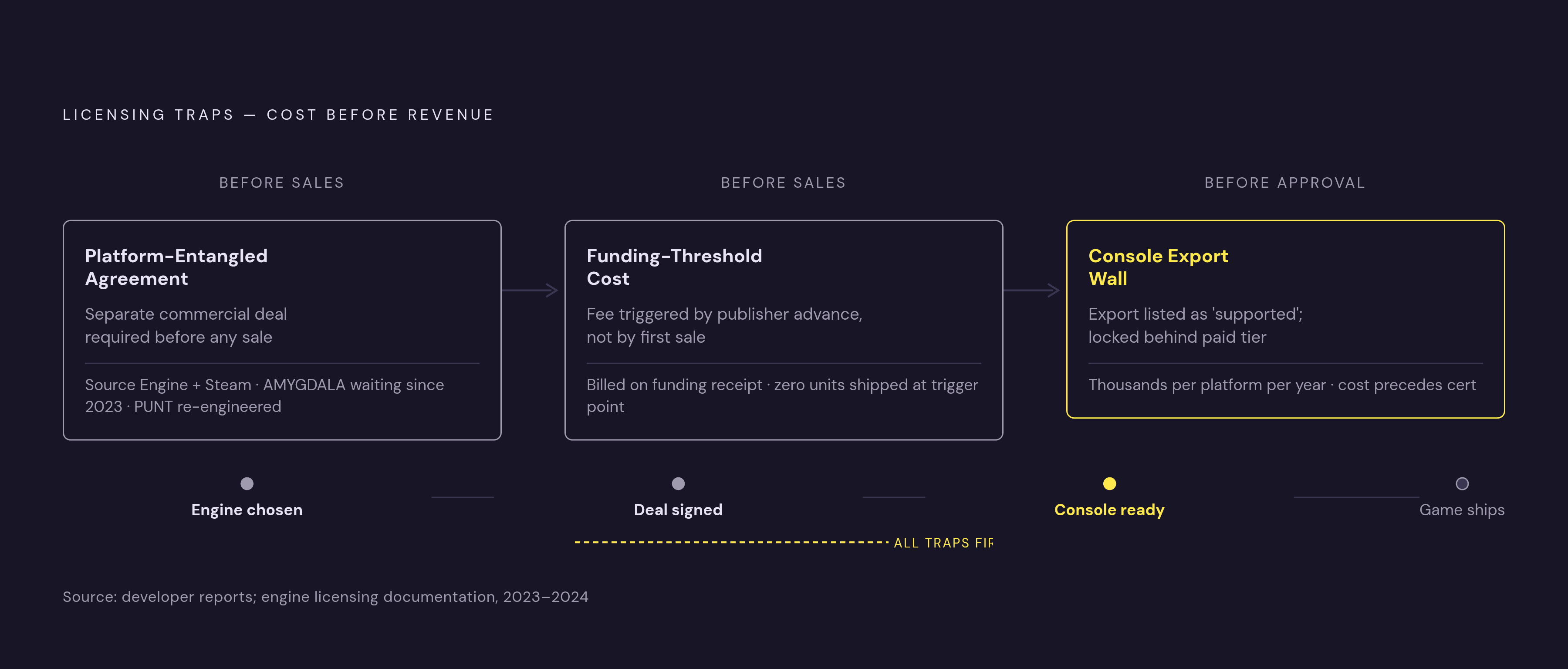
Permission to sell depends on where the game will ship, what terms apply to its funding or revenue, and whether someone else must sign an agreement. Three traps sit within that distinction. Platform-entangled agreements can make publication depend on a separate licensing decision, funding thresholds can create costs before sales begin, and console export restrictions can place advertised capabilities behind paid tiers. These terms come into play at different stages, often after a team has put in a lot of work. Non-coders are particularly exposed because the professional community’s warnings, forum discussions and hard-earned licensing heuristics may never reach them.
How the Source Engine licensing trap works, and the studios it has already swallowed
Valve’s Source Engine makes the distinction between ordinary platform review and commercial licensing concrete. Most games on Steam go through a standard review process taking three to five business days, although later queue delays complicate that expectation. Source games require a separate commercial agreement with Valve before they can be sold. That agreement has its own timetable, outside the developer’s control. Because Valve is both engine licensor and distribution gatekeeper, a stalled licensing process can prevent a studio from shipping or recouping its costs.
MOONLIT JOURNEYS, the three-person team behind AMYGDALA: Prelude, has been waiting since 2023 for that agreement. Its retro-style horror first-person shooter, set in 1990s Australia, has a free demo and a growing wishlist, and is roughly 80% complete. As of May 2026, no contract had arrived. The studio says Steam support asked for details, then months passed before support asked for the same details again. Its founder said, “It's painful watching everyone else ship their games every day whilst ours is stuck accumulating wishlists indefinitely but no one is able to buy”.
PUNT illustrates a different cost of the same dependency. The Source puzzle platformer was first announced in 2011 by reepblue, and its current developer, Caylee, began work in 2014. After years spent pursuing a commercial license, an ex-project lead publicly declared the game dead in July 2026. The outcome was a slow, arduous port to another engine that cost years of work because commercial permission was the obstacle.
What changed when Valve opened Source 2 to commercial use, and what still has not changed
Face Punch Studios, which is associated with Garry Newman, reached a Valve licensing agreement in April 2026 that lets indie developers release Source 2 games as standalone commercial products, royalty-free. The Facepunch (s&box) C# code layer is MIT-licensed on GitHub. A commercial pathway now exists where none existed before, and the first game built through it is already on Steam.
A third-party intermediary holds an agreement with Valve that could change, while the engine licensor and platform gatekeeper remain the same entity. Publishers may ask a studio to warrant that engine terms will not change materially during development and publishing. A studio cannot honestly give that assurance where the licensor retains unilateral change-of-terms rights, including this arrangement.
The funding-threshold trap that hits before a game reaches Steam at all
Other proprietary engines create obligations without requiring a separate platform-linked agreement. Some licenses determine eligibility for a free tier by “funding” rather than “revenue”, so a publisher advance above the threshold moves a studio onto a paid tier. No game sales are necessary to trigger it. A commercial obligation can therefore arrive while production is still consuming money and before the studio has begun recouping costs.
This differs from the intuitive appeal of a revenue share, under which payment follows sales success. Terms based on funding can make a studio pay when it gets the money it needs to finish the game. The distinction is easy to miss. An advance may feel like production support while also changing the studio’s position under its engine license. The relevant threshold must therefore be understood as a definition in a contract.
Non-coders face a particular exposure here because they may seek a publisher or investor to cover production costs they cannot fund themselves. They are also less likely to have read the engine agreement before accepting an advance or to have a lawyer identify the interaction. The mechanism is broader than any one engine’s current prices, which can shift with version updates.
The console export wall that "supported platforms" does not mean what it appears to mean
Many free engines list consoles among their supported platforms, although access to the export path can cost thousands of dollars per platform per year. A developer can face those costs before even asking for platform holder approval. For a developer reading a feature checklist, the missing distinction is between what the engine can produce and what the selected license tier permits.
Console export support means the engine can produce a console build once the developer has an approved developer account from each platform holder. No engine bypasses that approval, and a free engine tier does not make console publishing free. Some engines also require an enterprise subscription to unlock console export. With others, including MIT-licensed open-source engines, platform SDK costs are separate from engine costs, with no added engine charge.
The practical question for a team choosing an engine is therefore more specific than whether consoles are supported. It is what console export costs on that engine and which tier unlocks it. That question belongs before the selection decision. A platform checkbox alone does not resolve it, and the marketing page may not answer it directly.
How Steam's review queue became its own launch risk, independent of engine choice
A clear engine license does not guarantee a timely Steam launch. Valve’s published guidance advises submission at least seven business days before a planned release. Throughout October 2026, however, multiple indie developers reported reviews taking two to three weeks or more. By November 2026, Valve acknowledged a significant increase in submissions and said the process was taking up to twelve business days, with most of that time spent re-reviewing games that had issues at first submission.
Studio Daimon director Alfred Kamon submitted Food Devils on October 12, and by early November no replacement release date had been announced. A planned launch and an approved launch had diverged.
Developers identified a flood of AI-generated submissions as an indirect cause of the congestion, though that attribution is distinct from Valve’s acknowledgement of increased volume. Legitimate AI-assisted games face the same queue as other submissions. By mid-October 2026, Steam had released more games that year than in all of 2025, with two and a half months remaining. That volume makes review timing a planning risk independent of engine choice or licensing quality.
The AI content disclosure requirement Valve added in 2026 and what it actually covers
Valve’s revised disclosure policy distinguishes AI assistance used to write code from AI-generated content shipped to players. GitHub Copilot used to write game code requires no disclosure. Midjourney art included as in-game assets does, as does Suno-generated music included in the soundtrack. By early 2026, thousands of Steam games had disclosed AI content under the revised policy. The Epic Games Store has no disclosure requirement, making its submission environment different for AI-assisted developers.
Disclosure tells players what tools were used, while the Steam Distribution Agreement’s IP warranty is the developer’s legal promise that the game contains no infringing content. Those obligations operate independently but interact at submission. Warranting full ownership of AI-generated assets is complicated by the unsettled question of whether those assets are copyrightable at all.
The main legal exposure sits in four places, including the IP warranty given to a publisher or platform, the indemnity attached to it, assignment clauses in contractor and outsourcing agreements, and the AI tools’ own terms. For an AI-assisted team, the preparation is to document the content before submission rather than reconstruct its origins during the review window.
Why MIT-licensed open-source engines remove the platform-entanglement trap entirely
An MIT license removes the engine-side requirement to negotiate permission for a commercial release. Under that license, selling a game does not trigger a royalty at a revenue or funding threshold, and the engine maker cannot require a separate commercial agreement before publication. The platform retains its own review and contractual requirements.
Godot provides a concrete example of this foundation. Its MIT license allows commercial use, modification and shipping with zero royalties, zero seat fees and no revenue cap. The attribution requirement amounts to including the copyright notice and license text in the game’s credits. Including a COPYRIGHT.txt for third-party components is recommended but not strictly required.
The commercial record also extends beyond prototypes. Godot-powered titles on Steam have grown consistently, and over 35,000 Godot games had been released through mid-2026, with a substantial number shipping in 2025 alone. Its growing Steam presence has not yet produced a proportionate share of high-revenue titles. That commercial gap reflects a younger commercial community.
What non-coders actually get from Godot in 2026, with and without AI assistance
Commercial clarity alone would be insufficient if the engine were unusable for its intended audience. Godot lets developers make basic gameplay without coding through visual scripting and community plugins, but code works better for movement, combat, progression and save systems that go beyond the basics. The distinction is practical. A non-coder can only build so much in Godot without code, but can build much more with AI-assisted coding.
In that workflow, Claude, GPT, DeepSeek or Gemini writes the GDScript. Across different setups, the key difference is context rather than simply code quality, meaning what the assistant can see of the project and which actions it can take directly. Community-built Model Context Protocol bridges provide access to the real scene tree inside the editor. They let it work with scenes, scripts, nodes and playtests. That is a different working relationship from pasting isolated snippets into a chat window.
As of November 2026, the available setups span editor-based assistance and assistance in integrated development environments. Cursor paired with a Godot MCP server provides autocomplete and inline edits, while GitHub Copilot and Claude Code are also strong on GDScript quality. Ziva offers assistance inside the editor through a free tier and a paid tier, and AI Assistant Hub is free and open-source. GDAI MCP is a free option for connecting Claude or Cursor to a project through MCP.
These tools help non-coders build games without changing the engine’s commercial license. They make a clear licensing foundation more usable for non-coders while leaving Steam review, asset-rights obligations and console approval in place. Choosing for accessibility is entirely reasonable. Accessibility while building and safety when shipping are different properties, and in 2026 a developer can have both.