Which AI-Native Platforms Let Indie Devs Generate Assets Publish and Stay Under One Monthly Bill
Real consolidation means assets, engine AI, and publishing together.
An indie developer can consolidate AI spending, but asset generation alone does not make a platform a one-bill development environment. Genuine consolidation joins assets, engine-level AI, and a publishing path while leaving the developer in control of the files. The useful comparison is therefore not which platform offers the most generators, but which parts of the production pipeline it replaces and which choices it requires the developer to surrender.
Why indie AI stacks fragment across multiple subscriptions
Consider five invoices for five jobs, including code assistance, sprite generation, 3D modeling, music and sound effects, and voice. Each purchase solves a distinct production problem. Together, they leave a solo developer with several services to manage. The frustration comes from both the total price and the work of moving output between tools that specialize in different tasks.
Specialization is productive for exactly that reason. A tool built for GDScript autocomplete can outperform a general assistant on that task, while a style-locked 2D generator is better suited to sprites than a text-to-mesh tool. The purchases need not be irrational to become cumbersome. The economics of specialization pull against the goal of one monthly bill, so consolidation has to be judged by the work it absorbs as well as the subscriptions it groups together.
What "one bill" actually requires a platform to cover
The first test is coverage across three production stages. A one-bill platform needs to offer asset generation, engine-level AI, and a publishing path without a separate subscription for each. Within asset generation, 2D sprites, 3D meshes, audio, and voice are distinct categories. The assessment needs to cover music and sound effects as well as images. Covering two categories can cut some asset bills, but it covers only part of the asset budget.
The engine test is more demanding than file generation. Engine-level AI operates inside the editor, creating scenes, writing scripts, reading runtime errors, and correcting its work. An assistant that produces files for import leaves that integration loop with the developer. The publishing test then asks whether the project can reach a real storefront, including Steam, itch.io, a first-party games store, or mobile. Browser-only output without export does not meet that standard.
Ownership is the fourth test, and it governs the others. The developer needs to be able to export, modify, and sell the generated assets and code. Without those rights and capabilities, a broad feature set may still amount to a subscription to a prototype environment. These tests form a rubric. They distinguish a useful specialist from a platform that can support production through release.
Platforms that consolidate asset generation across the most pipeline stages
Ludo represents the breadth-first approach to asset consolidation. Its appeal is coverage across 2D, 3D, audio, and voice, which addresses several production categories through one asset-generation platform. That breadth is useful when asset variety drives the subscription count. It does not, by itself, establish engine-level integration or a publishing path. The developer still needs a place to put those assets together into a running game and build the release.
Scenario makes a different bet, emphasizing style consistency. It covers 2D, 3D, video, and audio, offers plans at multiple monthly price tiers, and ships an MCP server. Its main strength is custom-model training on a studio’s existing art style, which helps characters, environments, and UI look like they belong together. That training has a prerequisite. Because the training needs existing assets, it fits teams mid-production better than developers who are starting without reference material.
SEELE represents the third approach, emphasizing depth in 3D tooling rather than the same breadth or style-lock proposition. Breadth fills gaps in asset categories, style-lock keeps the look from drifting, and 3D depth serves those who need more from their 3D tools. None of these approaches replaces the engine on its own. They populate an asset library, but receiving those files, wiring them into gameplay, and producing a shippable build remain separate work.
Where engine-level AI changes the consolidation calculus
An external coding assistant occupies the first rung of the capability ladder. Claude Code supports agentic, multi-step work in the project’s files by reading them, making a plan, editing across a project, and running shell commands. That distinction leaves important integration work with the developer. Imports, scene wiring, debugging, and iteration are not automatically absorbed just because the assistant can edit several scripts.
In-editor plugins move the assistance closer to the game. Ziva and the Godot AI Assistant Hub operate inside the editor. Ziva’s hobby tier has a low monthly AI balance, while Basic costs $20/month. The Hub is free and open-source when the developer supplies an API key. Where the plugin runs and how it is billed need separate checks, since an editor plugin can still come with a bill for the AI service behind it.
An AI-native engine goes further by making AI the primary interface. At this rung, the agent can create scenes, configure nodes, write scripts to disk, run the game, read runtime errors, and self-correct. The feedback loop is the decisive difference. An in-engine agent can replace an external assistant while also absorbing integration steps that asset generators leave untouched. The rung a developer chooses therefore determines which separate subscriptions remain necessary.
How MCP servers change what a single subscription can reach
The Model Context Protocol gives an AI agent vendor-neutral access to multiple tools in one session. It connects capabilities without requiring them to belong to one platform. Scenario and Layer.ai both ship MCP servers so that compatible agents can use their generation tools. This changes the scope of an agent session. It does not mean that access to the agent includes every connected service in its subscription.
With suitable MCP servers, an agent can model an asset, export it, place it in an engine scene, and commit the work to a git branch. The developer no longer has to perform every transfer manually. Yet the asset generator, coding assistant, and engine can still be separate services, each with its own terms and bills.
Vendor neutrality also separates the workflow from one AI provider. A compatible server can work with Claude, another model, or a local model rather than binding the tool connection to a single client. That flexibility is useful for teams with established specialist tools.
What genuine full-pipeline consolidation looks like under one subscription
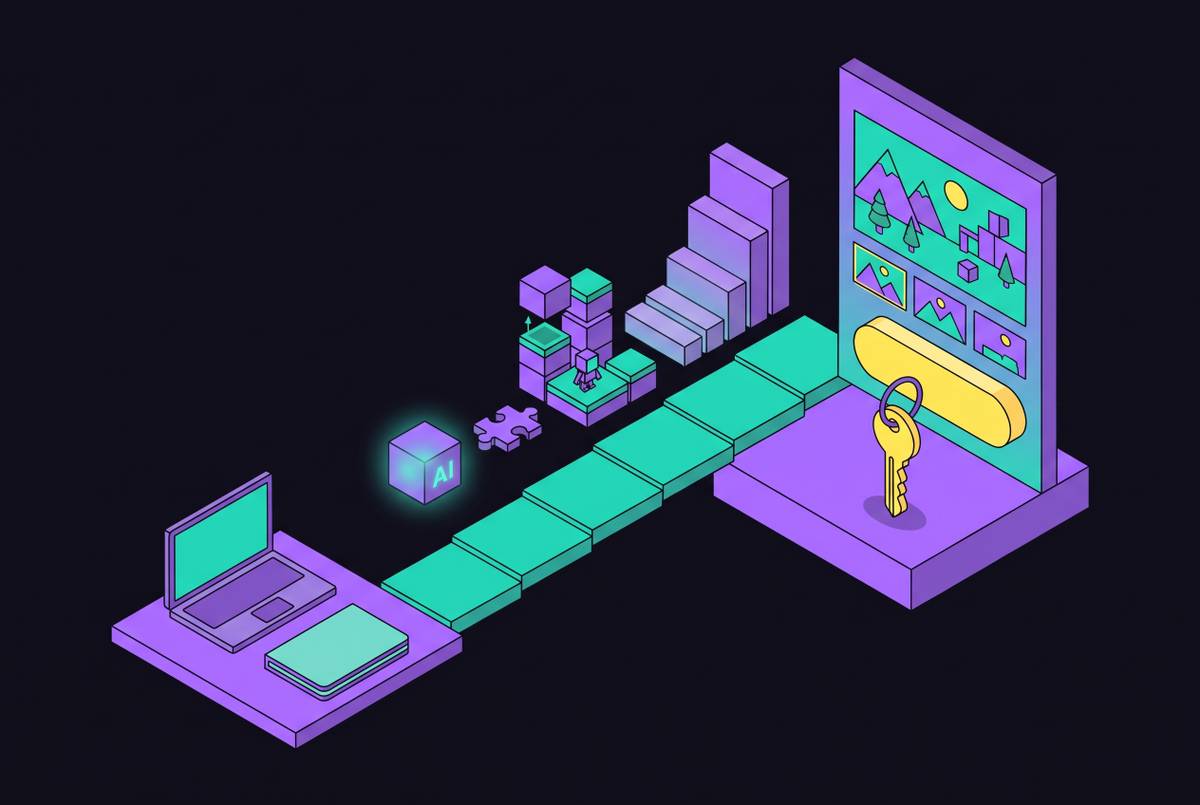
Full-pipeline consolidation requires the same project to move from generated assets through live engine work to an exportable build. All four tests must hold together. Asset breadth cannot compensate for an absent publishing path, and editor automation cannot compensate for output the developer cannot take away. A free export option is useful, but it proves only that part of the rubric. The subscription still needs to include the tools it claims to offer for making the game.
Godot 4 compatibility means GDScript, scene files, and export targets stay in standard Godot 4 format. That gives the developer project files usable outside the generating service and connects consolidation to an existing development workflow. The critical distinction is between an AI collaborator inside an editable project and a black box that returns locked output.
An integrated platform makes choices about the engine, asset pipeline, and deployment targets that a specialized stack leaves open. Those choices may remove work for one developer and constrain another with strong existing preferences. Nor does one bill imply unlimited generation. Compute is still metered, so making lots of assets can raise the bill for a single subscription even when the developer no longer has to manage several services.
Publishing rules that apply regardless of which platform the developer chooses
Steam’s January 2026 update places stricter guardrail and reporting requirements on live-generated content, including NPC dialogue written in real time. Steam and itch.io both allow AI-generated content and require disclosure, but each has its own process for publishing. When checking the live-generation requirements, the developer needs to distinguish content made during development from content made during play. A platform’s export capability does not take those responsibilities away from the developer.
Developers can publish there for free on the same day through a drag-and-drop zip upload. Steam instead charges a one-time per-game submission fee and reaches the largest PC audience. Its review process also requires release planning. Delays of up to twelve business days have been described, with developers attributing slower queues to the volume of AI-generated submissions, although that attribution is not an established explanation of every delay.
The practical release sequence is to publish on itch.io first to test the build and gather feedback, then launch on Steam once the game is polished. This spreads the disclosure and review work across time. It also makes portability a production requirement rather than a contractual detail considered after development. A browser prototype without export cannot support that progression.
How to decide which consolidation trade-off fits your project
The decision starts with the bottleneck. For an asset-heavy project needing 2D, 3D, audio, and voice, a broad platform such as Ludo addresses several asset invoices while leaving the engine and publishing path separate. If the harder problem is consistency across a large existing asset set, Scenario’s custom-model training addresses visual drift more directly. That choice depends on having material to train from.
For a code-heavy project, the next question is where the work stalls. An external assistant suits multi-step editing of files, while in-editor assistance brings the agent closer to scenes and runtime feedback. If integration itself is the bottleneck, an AI-native engine offers the more complete loop. Existing tool preferences change that calculation. A developer who wants to preserve specialist services can use MCP for cross-tool coordination without treating it as a reduction in subscription count.
For a publish-focused developer, the first branch is export. A platform needs to support portable project output and a route to a real storefront before generation breadth becomes decisive. The itch.io-first, Steam-later sequence provides a practical route when those capabilities are present. Across all three profiles, the final filter is the same question. Does the platform produce files the developer owns, can export, and can publish to a real storefront? If not, it remains a prototype environment regardless of how many features sit under its monthly bill.