Why Itch.io and App Store Publishing Belong Inside the Engine Not the Export Menu
Exporting a build isn't shipping, and the engine should know it.

Publishing to itch.io, Steam, and app stores belongs inside the engine because an exported build still requires work to become a release. For time-constrained creators, the difficult handoff begins when the editor stops helping. An AI-native workflow that coordinates code, assets, and scenes should also coordinate validation and deployment, without taking ownership of the game or making its release pipeline proprietary.
Why the export menu is the wrong place for publishing to end
A creator pressing “export” can reasonably expect to be approaching a playable release. What the export menu actually produces is a folder of platform binaries. Making those files available as a live storefront product still requires a URL for players to visit and a listing with metadata, capsule art, and pricing. The distinction is between producing the game’s files and making the game available to its audience.
Export templates that match the version and presets for each target get the build ready, while store SDKs and upload tools connect it to a distribution platform. These steps fall on both sides of the export boundary, with no single publishing workflow to bring them together. The creator must cross that boundary with separate tools and know-how that the engine does not bring together.
That boundary becomes harder to justify when an AI agent already handles code generation, scene editing, asset import, and runtime debugging. The editor can help resolve a problem inside the game, yet leave the creator alone with the requirements for making it playable. Treating export as the end of the engine’s responsibility leaves the release dependent on work outside its awareness.
What the manual publishing stack actually requires after export
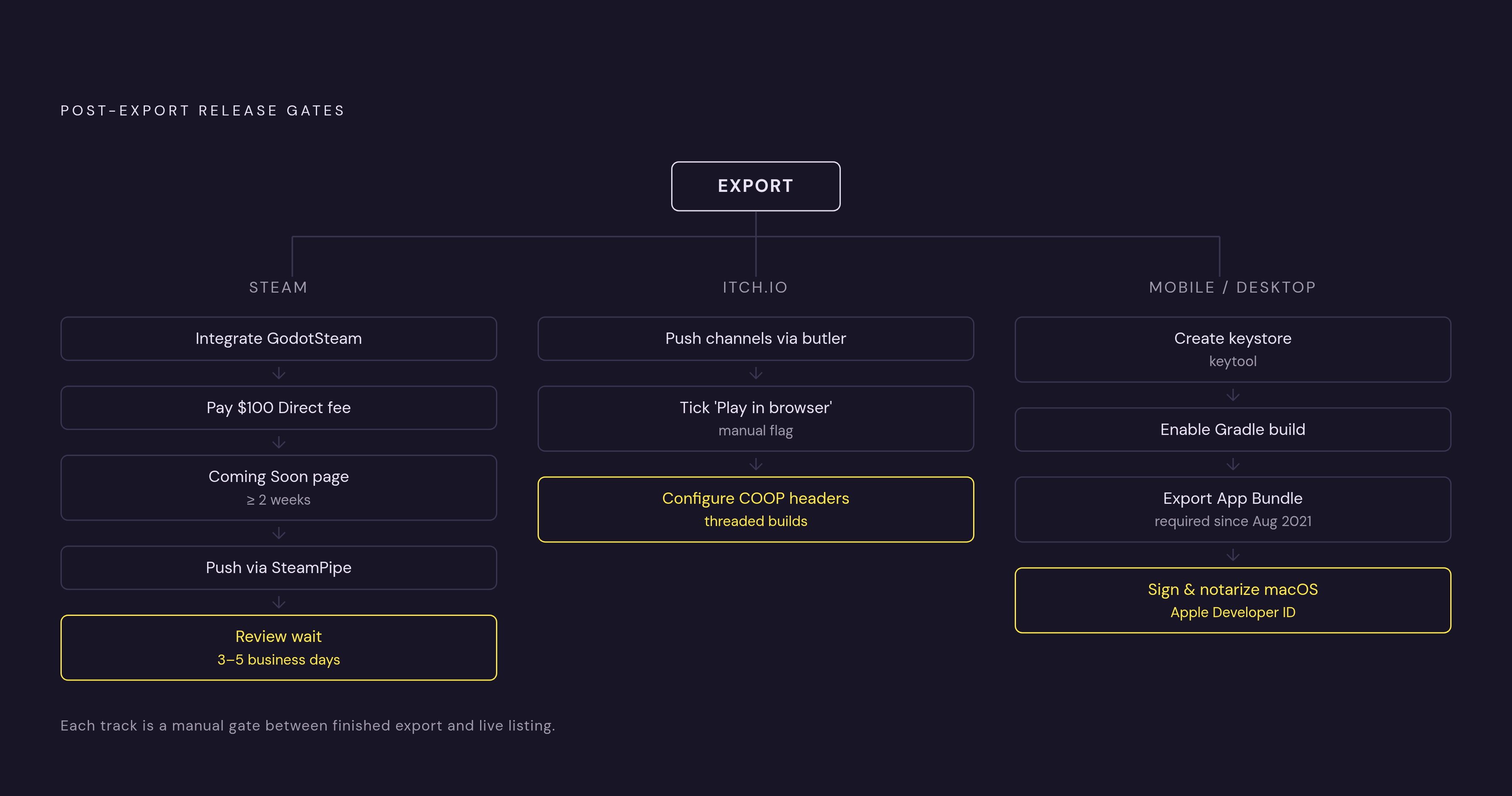
The manual release process begins with a change of tools and responsibilities. For a Godot game headed to Steam, the developer integrates Steamworks through GodotSteam and pays the $100 Steam Direct fee per game, reclaimed after a threshold of adjusted gross revenue is reached. The store page must run as Coming Soon for at least two weeks before release. A desktop build then reaches Steam through SteamPipe. Build review usually takes three to five business days, so finishing an export alone does not tell the developer when the game can be released.
On itch.io, the developer uses butler to push each platform channel separately. Butler handles incremental uploads after the first push. Setting a build as playable in the browser requires opening the game’s edit page and ticking “This file will be played in the browser” manually.
Godot 4.3 or later exports single-threaded by default, which runs on ordinary hosting, while threaded builds require cross-origin headers. These compatibility constraints, including the unavailability of web export for C# projects, span the editor and hosting environment and lack a complete release check.
Mobile and desktop distribution introduce further requirements. Android releases require a release keystore created with keytool, an enabled Gradle build, and an exported Android App Bundle. Since August 2021, new apps on Google Play have had to use App Bundles. For macOS downloads, the developer must sign and notarize with an Apple Developer ID certificate so Gatekeeper does not block the download. Unsigned, un-notarized builds downloaded from the internet are blocked.
Steam, itch.io, Google Play, and the Apple App Store each have their own rules for assets and compliance. The release therefore depends on a sequence of build settings, credentials, upload operations, and store configuration, any of which can leave the exported game short of its intended destination.
Why itch.io and Steam have meaningfully different gatekeeping economics and audiences
Itch.io and Steam serve different stages of a game’s life and different tolerances for release risk. Itch.io costs nothing to list on, offers a default revenue split favorable to developers, and has an upload flow completable in minutes to hours. That suits jams, early access, demos, and pay-what-you-want builds. A creator can use it to put an unfinished or narrowly scoped release in front of players without Steam’s financial and scheduling commitments.
Steam introduces a different release rhythm. Its fee, Coming Soon period, review window, and integration work all need planning beyond getting a build online. These are not interchangeable publication targets. The practical sequence many indie developers follow is to publish on itch.io for testing and feedback, then launch on Steam once the game is polished. A publishing workflow therefore needs to help creators move from one store to another, while treating each as more than just another place to upload files.
Speed alone is not enough on itch.io, either. Large numbers of automated or low-effort submissions create a crowded field for developers who have invested substantial time in their projects. Accurate metadata, appropriate store art, targeted tags, and a playable HTML5 embed help distinguish a polished release. That presentation work remains outside current engine workflows. Integrating publishing would need to address the quality of the listing as well as the movement of files, without pretending that either guarantees discovery.
How the community has already started patching this gap from outside the engine
GodotPipe, by fourgames, provides a concrete example of demand for a more complete workflow. The desktop app exports a Godot project and uploads it to itch.io with butler, to Steam with SteamCMD, or to both. It exports each row once, then uploads to Steam first and itch.io second in the same console. Before export, it checks with each store that the upload can work. A failed check for one store does not stop the other.
The tool also checks the interval between export and upload. Every build the local machine can run is checked for scripts that fail only in an exported build, such as a script that uses EditorInterface. When the tool finds a problem, it names the file and stops the upload before that code reaches players. This is more than a convenience button. It joins build validation to deployment at precisely the point where an export-only workflow loses oversight.
GodotPipe is itself sold on itch.io. That a tool for this work is sold on the very platform it helps creators publish to shows there is a market for it. Separately, developers use the barichello/godot-ci Docker image with GitHub Actions and GitLab CI to automate headless exports and butler pushes on git-tag triggers. Deployment runs only after the CI job completes successfully.
These workarounds demonstrate that the individual operations can be joined. They do not establish that the editor’s workflow is complete. Each remains outside the engine, requires separate credential management, and is invisible to an AI agent working inside the editor.
Why the post-export gap hits AI-activated creators hardest
AI-assisted development compresses prototyping, code scaffolding, and asset generation from months into days, but leaves polish, playtesting, and shipping to be completed. That changes who reaches the export menu. Composers, QA engineers, designers, and developers with day jobs can now build games even if they have never shipped one before. Their ability to create a working project does not imply fluency with store deployment.
Butler and SteamCMD require command-line fluency, Steamworks requires partner portal navigation, and exports depend on version-matched templates. These skills belong to release engineering rather than to the creative task AI has made more accessible. Faster creation exposes the discontinuity sooner.
Publishing also means deciding how to meet the rules, which takes more than uploading files. Godot Wild Jam #99, scheduled for November 13–22, 2026, states “Do NOT use AI-generated content. No vibe code, no AI-generated art, no AI-composed music, no AI-written dialogue, no AI assets of any kind,” with the rule applying to both the game and its itch.io page. Submissions are removable at organizer discretion. The time-bound event makes the consequence concrete, since completing a build is insufficient if the page itself violates the submission rules.
That policy shows that a gatekeeper can treat the game and its store page as one submission. Metadata and page content are therefore part of the creative and compliance workflow. A publishing system built into the engine must follow the rules of the store or event, since generating more content will not always help a creator ship.
What it would mean for publishing to live inside the engine rather than after it
Publishing belongs inside the engine when the agent building the game can also validate, configure, and deploy it. An agent in the running editor can have access to the scene tree, project settings, GDExtension plugin list, and runtime diagnostics. Those are also inputs to judging whether an export is ready. Separating release validation from that context forces the workflow across a boundary that does not serve the creator’s task.
In practice, the same agent should be able to inspect settings, run the game, read errors, and confirm that the build is clean before invoking an upload tool. The workflow should check store credentials and configuration before the upload starts. Failures should return to the place where the developer is already working. GodotPipe’s independent store checks illustrate why this design needs more than a single success-or-failure result for the entire release.
The asset layer belongs in that loop as well. Publishing needs material made for each store, including Steam capsule art at the required sizes and trailer shots, as well as the assets used during gameplay. An integrated workflow would make those outputs available as files the developer can use directly in the project or store page. Where a destination restricts generated content, that restriction must remain part of the workflow. Integration should connect the required work while preserving the distinction between technical readiness and permission to submit.
Butler and SteamCMD are store-side tools. An agent invoking butler push from inside the editor is no less portable in principle than a CI/CD YAML file invoking it from outside. The location of the control surface does not determine ownership of the pipeline.
The standard is therefore an unbroken working loop. Inspection, validation, store-asset preparation, and upload should share context, with errors surfaced where the creator can act on them. A new checkbox in the export dialog would not meet that standard if credentials, browser settings, and deployment failures still required an unrelated manual process.
What creators should actually evaluate when choosing a publishing-aware engine
Creators choosing an engine should test whether its agent can complete the release loop. Can it read runtime errors and establish that a build is clean before upload? Can it produce capsule art, screenshots, and trailer material in the required dimensions for each target? Those questions distinguish a publishing workflow from an export shortcut. They also expose where the developer must still move into separate tools.
Does the pipeline validate credentials before initiating an upload, and can one store proceed when another fails its checks? Does completion still require manual credential management, command-line work, or store dashboards? The answers reveal the actual boundary of the integration. A workflow that makes that boundary clear is more useful to evaluate than a broad promise of one-click publishing.
Output ownership is the final test. Can the developer export games to Steam, itch.io, and mobile, or does the system produce browser-only prototypes that cannot be listed on a real storefront? Does it use standard tooling such as butler and SteamPipe, or establish a proprietary dependency? Publishing support should give the developer more ways to distribute a game and keep those ways open if they leave the engine.
Godot’s MIT license provides a concrete ownership baseline. It imposes no publishing fee or revenue share, and its license terms do not apply to the content created with it. Developers must still put Godot’s copyright notice and license text, along with the third-party library notices in COPYRIGHT.txt, in the game’s credits or documentation. Store charges remain distinct from engine licensing. The standard is integrated publishing with developer-owned output and a portable release pipeline, because inside the engine must never mean trapped in the engine.