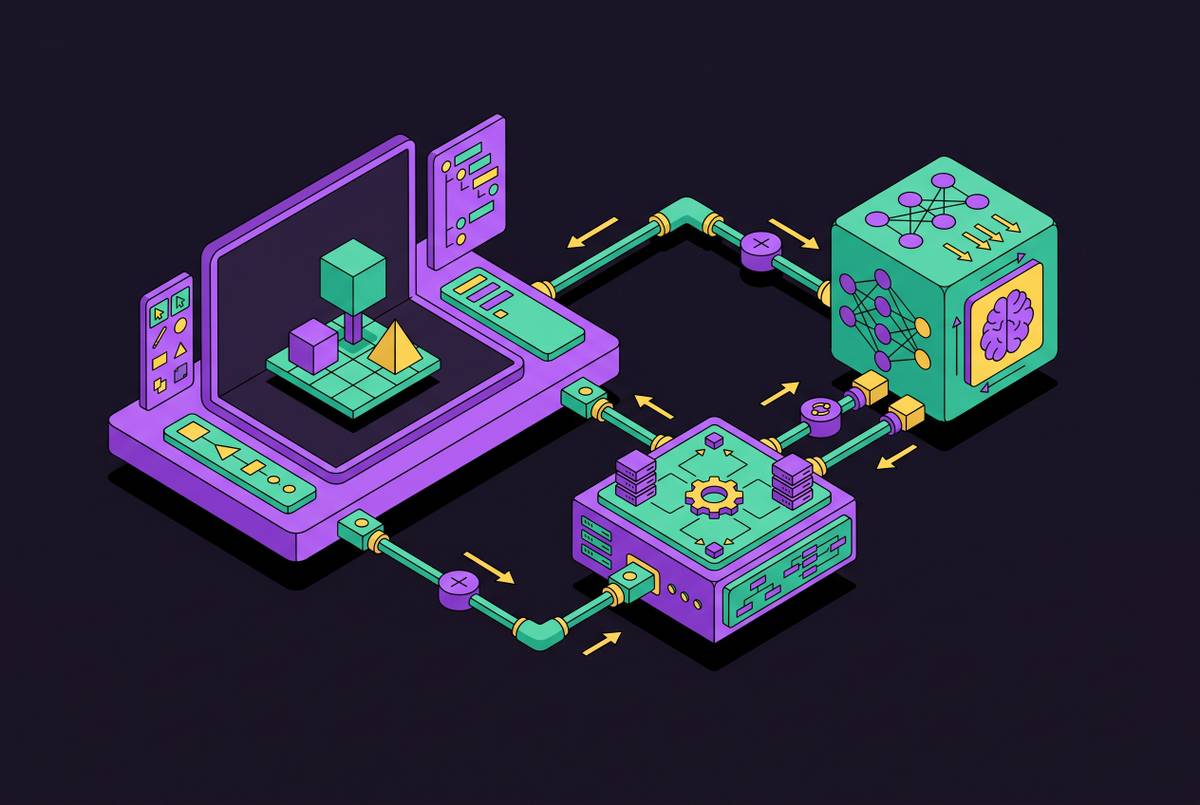
Vertical Slice Completion Rate With AI Game Development Tools
AI tools speed asset production but don't automatically raise completion rates.

AI game development tools make the vertical slice a more achievable early checkpoint by shortening asset production and routine implementation, but they do not replace integration or scope discipline. For a Godot-compatible AI coding assistant for GDScript, the key distinction is access to actual project state, through MCP or native integration such as Summer AI. The evidence shows that production takes less time, but it does not measure a rise in vertical slice completion rates across the industry.
Why the vertical slice has always been the hardest milestone to reach
A vertical slice is the first playable path in which design, code, art, animation, audio, and UI must work together at the intended quality. A prototype can establish that an interaction is promising without proving that the production process can support it. The slice carries that second burden. It tests whether the core loop can sustain full production and whether the team can deliver the planned content volume with its available tools.
That makes the milestone difficult in a way that an isolated system demonstration is not. Combat can work without animation, feedback, camera framing, and encounter pacing working well together. Each part must support the others in the same build. The team must also check whether it can repeat the production process or whether the result took an unusual amount of effort.
The classic mistake is to answer that challenge with breadth. Polished combat, multiple enemy types, inventory, settings, accessibility options, and final-quality art can absorb months without resolving the central production decision. The value of these systems depends on what the slice must prove. A useful slice is therefore not “the game, but shorter”. It is deliberately narrow evidence for a decision about continuing production.
Where indie projects actually break down before reaching that milestone
Most indie developers work alone, so work that a larger team would distribute lands on one person. Concept art, 3D modeling, UV unwrapping, weight painting, voice-over, and music each carry multi-day timelines. Producing enough of them at target quality can delay the first meaningful test of the whole experience.
Once those parts exist, iteration becomes the next constraint. A change to combat timing, camera framing, or encounter pacing can require changes across code, art, and audio. The developer has to do all that work to try out one design change before seeing how it plays. When that feedback loop is slow, pre-production extends by weeks even though individual tasks appear to be progressing.
Endurance erodes in the gap between that visible activity and a playable result. Unfinished assets, slow feedback, and poorly bounded scope make the remaining work feel unclosable. Adding save systems, platform SDKs, or localization before they are needed introduces more dependencies without necessarily strengthening the milestone. Each new task makes the other bottlenecks harder for a solo developer to clear.
How AI tools are compressing the three bottlenecks — and where the gains are real
AI asset generation shortens some multi-day workflows to hours, while concept art, voice-over, and music generation can reduce pre-production work from weeks to days when used carefully. The practical gain is the ability to test an interaction before every supporting artifact has passed through a separate production pipeline. That brings feedback forward, when changes are less entangled with finished work.
The available tools address different parts of that gap. ElevenLabs produces placeholder or shippable character voices, while AIVA supplies cinematic and orchestral music with commercial licensing on its Pro plan. AIVA’s Standard plan permits only limited social-platform monetization. Inworld AI provides voice generation, dialogue memory, emotional responses, and personality APIs for NPCs. Its dedicated character-studio product was retired in 2025, so developers now assemble these capabilities through the Agent Runtime and modular APIs.
Code assistance has a more clearly bounded result. Althera Games’ 2026 time-tracking over a four-month sprint showed a 38 percent reduction in time-to-first-working-implementation for routine systems, including inventory, save/load, and basic AI states. Savings were much smaller for systems the developer had never built before. Reading and critically validating unfamiliar output remained necessary.
Iteration can also become more direct. Summer Engine lets developers describe design changes in plain language and see them reflected in the running game instantly, reducing the context-switching involved in translating intent across code, art, and audio. That addresses a different cost from typing code faster. For a solo developer, a shorter route from intention to visible result also narrows the gap that feeds abandonment. This endurance benefit is harder to quantify than implementation time, but its mechanism is clear, as the developer spends less effort producing every artifact and more effort directing and evaluating the result.
How Godot's MCP ecosystem makes AI assistance project-aware rather than generic
For Godot 4 development, autocomplete and project-aware assistance answer different needs. Generic code completion such as GitHub Copilot can help with typing, but without scene-tree access it has to guess how the project is set up, including node names and how they relate. It can also drift toward Godot 3 syntax when uncertain. The relevant comparison is therefore not simply which assistant generates GDScript. It is whether the assistant can inspect the structures that the script must use.
The Model Context Protocol, or MCP, supplies a bridge into that project state. The satelliteoflove/godot-mcp implementation connects a server to an editor addon over a local WebSocket. The addon reaches the running game through Godot’s debugger protocol, while the server translates AI-IDE tool calls into messages the addon can handle. This gives an agent access to scene information and runtime operations rather than leaving it to infer the project from individual files.
Capabilities still depend on the implementation. The satelliteoflove/godot-mcp toolset covers scene and node editing, tilemaps, runtime state, and profiling, but deliberately does not duplicate scene construction as a dedicated tool. Setup involves an editor plugin, server bridge, client configuration, and a sanity test. Claims of roughly fifteen-minute setup should not obscure the working knowledge those steps require. Explicit type annotations in GDScript also help tool calls succeed, so care with typing affects how well the assistance works as well as how the code looks.
For slice work, access to the actual scene tree matters most when separately built systems meet. An agent that can check scene state and run GDScript at runtime can help with integration as well as make file edits faster. With native integration, Summer AI works inside Summer Engine on the same project state the developer sees, without an external bridge. Both routes to project awareness still require developers to understand GDScript and review changes.
What adoption data actually shows about AI in shipped games
Steam’s mandatory content survey provides a useful distinction between intended adoption and use in released products. Its AI content disclosures concern games that have reached the market. The disclosure trajectory is evidence that AI-generated content is entering production pipelines. But it does not track every kind of coding assistance or show which tools helped a project reach its vertical slice.
More importantly, a disclosure rate cannot establish that an AI-assisted game took less time, had fewer integration problems, or achieved a stronger core loop. Games that shipped also cannot show how many similar projects stalled before they were finished.
Krafton’s production plans show that the shift extends beyond indie development. Krafton declared itself an “AI-first” company and committed capital to a GPU cluster and ongoing annual AI tooling investment. It targeted completion of its AI platform and data integration/automation foundation at the second half of 2026.
What AI compression does not fix — and the new risks it introduces
The strongest objection to the completion argument is that access and quality are independent. A tool can make a playable build easier to produce without making its defining interaction more compelling. Faster production also does not improve discoverability by itself. Even if more developers reach a vertical slice or release a game, neither result establishes a higher commercial success rate.
It also changes where technical costs appear. Generative asset pipelines can produce unoptimized meshes that damage framerate, while generated code can introduce hidden dependencies that emerge only during integration. Shaders still need profiling against the target platform. A developer unable to evaluate code, mesh topology, or audio quality may accumulate debt while the project appears to advance. The saved production time is meaningful only if evaluation and cleanup do not consume it later.
Scope remains another human constraint. AI makes additional features easier to start, which can encourage breadth before the core interaction has been validated. Content that looks finished can then make it harder to tell whether that work helps the team decide to go ahead with production. No increase in generation speed determines which experience defines the game or which systems can be cut.
For that reason, the vertical slice becomes more important in an AI-assisted pipeline. It must validate both the core loop and the ability to integrate generated assets and systems at target performance. A convincing standalone asset or working script cannot answer that combined question. The slice is the earliest point at which the real costs of AI-assisted production become visible together.
How to scope a vertical slice for an AI-assisted solo pipeline
Start by writing the decision the milestone must support before opening a generation tool. The statement should ask whether the core loop is strong enough to justify full production, rather than promise combat, inventory, a level, and a boss. Include only the systems that must interact for the player to make the game’s central decisions. This boundary matters more when AI makes additions cheap to begin. A feature that is easy to generate can still be expensive to integrate and difficult to cut.
Use generated assets early to unblock those decisions while leaving the final art style open. Placeholder character models, environment tiles, and audio stings let the team test at close to the target fidelity without all the work needed for final production. Treat that first pass as design material. Text-to-3D workflows that produce rigged, animation-ready assets in under an hour are especially useful at this stage.
Integrate these parts as they arrive rather than reserving integration for the final two weeks. Faster isolated production is not evidence that the assembled result will work. Use project-aware agents where access to scene state can support cross-system changes, and capture screenshots and run profiling passes within that workflow. Typed GDScript and careful review are still needed even when the agent can check the running project. Performance problems belong inside the slice’s evaluation.
In an AI-native environment such as Summer Engine, dialogue, music, video, and model generation are bundled into one tool. Summer Studio makes the assets, while Summer AI works inside the engine. Godot 4 compatibility and support for GDScript, C++, and C# give existing projects a route into that workflow without rebuilding from scratch.
Before starting to produce a wide range of content, look at player behavior, technical data, and how much work production took together. If every generated mesh required manual cleanup or AI-written code needed substantial hand-editing, the pipeline is not ready merely because the slice looks complete. Use the measured effort to confirm or revise the budget and timeline. The decisive outcome is a slice that demonstrates a core loop worth expanding and a production process capable of repeating the result.