AI-Assisted Playtesting and Bug Detection in Indie Game Projects
AI playtesting tools find bugs solo developers miss, but human judgment still matters most.
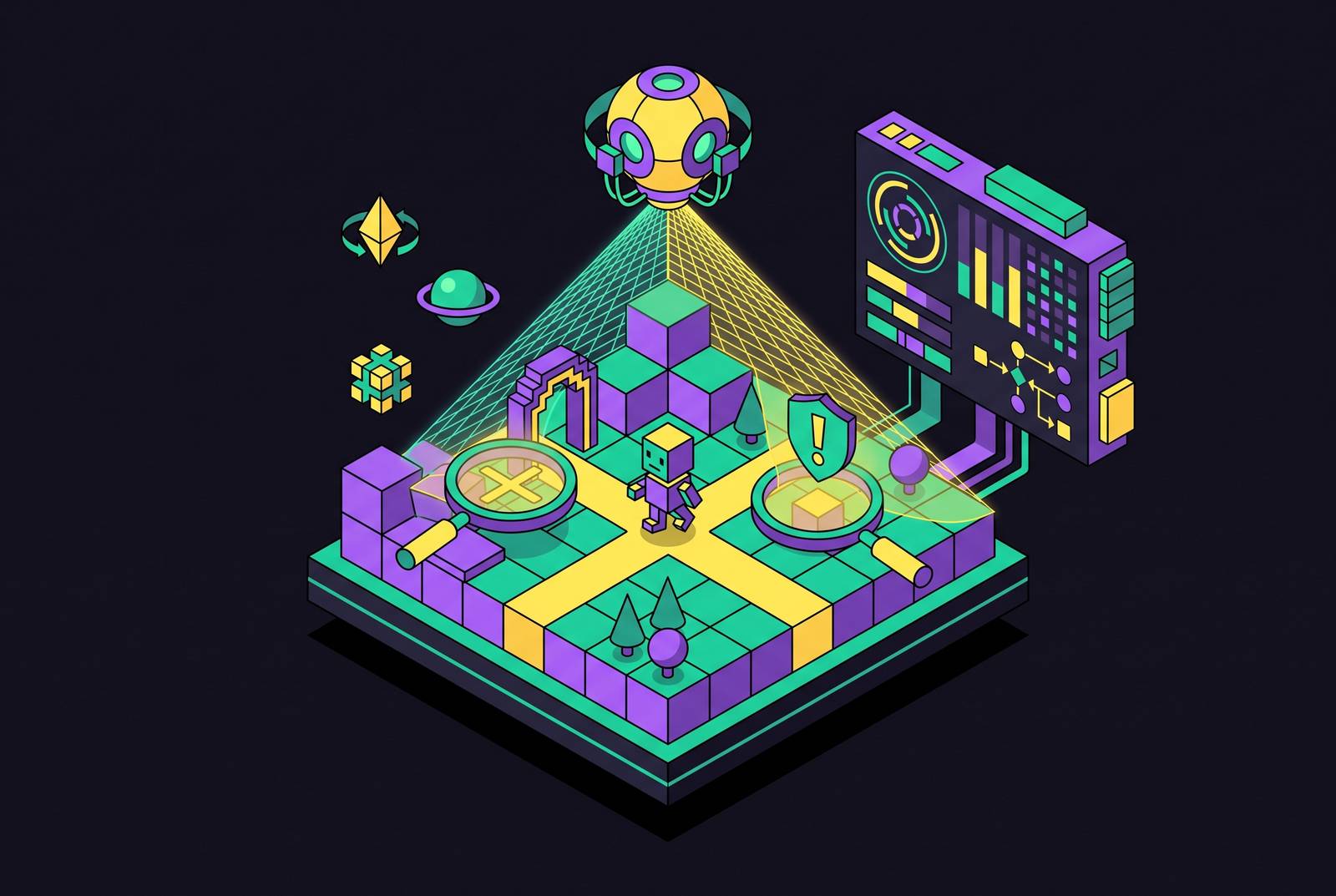
AI-assisted playtesting and bug detection help indie developers check edge cases in a way they rarely do when testing their own game. Vision models inspect gameplay footage, autonomous agents explore builds, and MCP-connected agents run tests through development tools. Together, these approaches address a structural QA gap, but human testers remain essential for judging feel, pacing, accessibility, and experience quality.
Why indie games ship with bugs that solo developers never see
A small team finishes its game and realizes that everyone who tested it also helped build it. The testers know where to go, when to save, and how each objective should resolve. As a result, their playthroughs tend to follow the intended path. Saving mid-quest, loading with a full inventory, completing an objective while dying, or pausing during a cutscene exposes a different set of interactions.
AAA studios have large QA teams that test for months before launch and still ship serious bugs. A solo developer can check less of the same interaction matrix, and static analysis cannot reliably find faults that occur only during play. Perceptual and behavioral bugs require observation of what the game actually displays and does.
Summer Engine embeds conversation-driven game building and an in-engine AI agent into development, letting creators describe game logic in plain language and test whether its implementation matches that intent. This brings testing closer to the point where behavior is defined. It does not remove the need for broader playthrough coverage.
What AI playtesting systems actually do, and the three technical approaches in use
AI playtesting fills the space between a team testing its own work and a dedicated QA team examining it. Its main contribution is repetitive, systematic exploration, supported by analysis that surfaces anomalies for review. Three approaches provide that coverage, namely vision-based detection, autonomous agent playthroughs, and MCP-connected test loops. They differ chiefly in what they can observe and how they interact with the game.
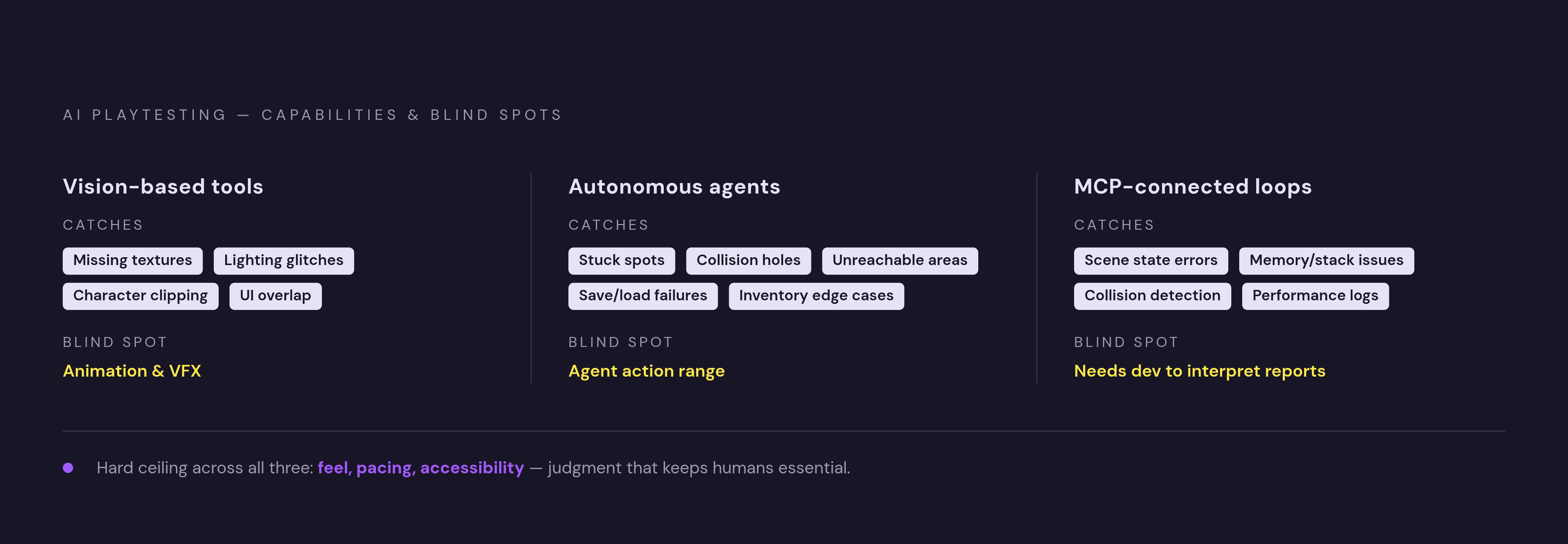
Vision-based tools watch live or recorded gameplay and point out visual anomalies, performance drops, UI problems, and graphical bugs. They work without code changes and can attach video evidence to a report, making them accessible when a developer has footage but no testing integration. Autonomous agents instead generate player sessions through reinforcement learning or scripted behavior. They try out paths and combinations to find stuck spots, balance issues, and design flaws.
MCP-connected test loops give an AI agent access to a live build through a protocol layer. Depending on the connected system, the agent can inspect scene state, execute actions, detect collisions and errors, and produce structured reports. This approach fits developers who already use AI coding assistants and want to extend that workflow into testing. None of those capabilities makes the system a judge of whether the game is enjoyable.
What vision-language models catch in gameplay video, and where they fall short
The University of Alberta and Electronic Arts research on automated bug frame retrieval evaluated a pipeline that uses FFmpeg to extract keyframes from gameplay video. GPT-4o then compares those frames with a text bug description and selects the most representative frame. The extraction step retains bug moments in the vast majority of cases while reducing the footage to a small fraction of its original frames. For triage, that means less manual searching for the moment a reported fault appears.
The research reports that the models did well overall and were most accurate on Lighting & Shadow, Physics & Collision, and UI & HUD bugs. Animation & VFX is the weakest category, so success at locating clipping or UI overlap should not be treated as proof that motion-related faults are equally well covered. The University of Alberta and Electronic Arts study of visual bug detection in long gameplay recordings also evaluates a different task, asking whether a frame contains a bug without supplying a matching report. Its findings qualify the promise of general visual reasoning in practical QA. Finding evidence for a described bug and discovering an unknown bug are not interchangeable measures of capability.
Ontario Tech University research takes another approach, using LSTM-based anomaly detection to find frames that differ from what the model has learned is normal behavior. Its framework was evaluated on FPS games and uses DBSCAN clustering to categorize detected bugs. This backs the use of observation-based testing for faults that rule-based checks cannot catch, though people still need to review animation and visual effects. All such approaches share a dependency, however. They inspect events that occurred in footage, so a human session or an autonomous agent must first generate that footage.
How agent-based playtesting finds bugs that nobody thought to look for
Autonomous agents supply that footage by playing the game themselves. Their advantage is not that they understand the intended experience better than its developer. Their independence from the developer’s unconscious preference for the correct route lets them explore paths and combinations that look obviously wrong to a person, bringing neglected parts of the game into the test run.
Reinforcement-learning agents are particularly useful for navigation faults, including stuck spots, unreachable areas, collision holes, gaps in invisible walls, and places where a player can fall out of the world. Agents that connect to game systems through an API can also test combinations of save/load cycles, inventory operations, quest progression, and combat sequences. ManaMind and nunu.ai are agent-based tools that find edge cases, balance issues, and design flaws in game builds. ManaMind works through audio and video inputs without the need for API integration, so very small teams have one less setup step.
Agent output nevertheless needs interpretation. A reinforcement-learning agent seeks to maximize its reward function and may progress in an unintended way, including behavior that breaks game rules or the physics engine. What appears to be a discovered fault may therefore be entangled with the agent’s reward design. The developer must distinguish evidence of a game problem from behavior produced by the testing setup. Systematic exploration is valuable, but its reach remains bounded by the actions the agent can attempt.
MCP-connected test loops: the most practical path for indie developers already using AI tools
For developers who already use AI coding assistants, MCP-connected testing is the most direct way to move from building the game to QA. The protocol connection that lets an assistant work with development tools can extend into a live testing loop. The available capabilities depend on the specialized MCP system connected to the agent.
Those systems can expose active scenes, memory and stack logs, collision detection, and performance logging. A coding agent can use that access for multi-file inspection and structured bug reporting without requiring a person to direct every intermediate step. GDC 2026 featured roughly 40 game-development-focused MCP servers in its first dedicated MCP showcase.
For a developer using Summer Engine, its in-engine agent, Summer AI, can be directed toward systematic testing tasks without assembling a separate external toolchain. Its conversation-driven logic building, generative asset creation, and in-engine AI support let developers test as part of the way they already build. This provides a different starting point from connecting an external assistant. In either case, useful testing still depends on inspecting failures and producing reports that a developer can act on.
What AI playtesting reliably catches, and what it consistently misses
The strongest coverage comes from matching each technique to the fault it can expose. Vision-based tools are well suited to missing textures, lighting glitches, character clipping, and UI overlap. Navigation agents can find stuck spots, collision holes, fall-through geometry, and unreachable areas. Agents that test system APIs can find save/load failures, inventory edge cases, and quest state corruption caused by events that happen at the same time. Checking telemetry during agent runs can show performance patterns such as frame rate drops when certain actions take place and memory issues at scale.
A tool that detects a collision fault cannot establish whether combat feels satisfying or a difficulty spike feels engaging or frustrating. People also need to judge the story’s impact and pacing. Vision-language models still do less well with animation and VFX because complex motion makes it harder to spot anomalies reliably. Automated contrast and readability checks also leave much of accessibility unresolved, including whether a new player finds a control scheme intuitive.
Coverage has a further boundary in the test configuration itself. An agent cannot discover an interaction it has no way to attempt, however thoroughly it repeats the actions available to it. Consequently, a clean run provides evidence about the tested behaviors. The practical division is AI for systematic coverage of known fault categories and humans for qualitative assessment and unexpected player behavior.
Building a practical AI playtesting workflow for a small team or solo project
During development, the first stage is an MCP-based connection to the live project for scene inspection, script errors, and physics and collision checks. The purpose is to catch faults while individual systems are being built, before their interactions become harder to untangle. For a solo developer, even a basic loop that launches the build, navigates to each scene, and logs errors to a file replaces repetitive work that otherwise goes undone.
At feature completion, the second stage shifts from inspecting individual systems to exercising their combinations. Agent-based playthroughs can cover save/load, inventory, quest progression, and combat sequences that the team has not manually tested together. The states that agents report need to be checked because unexpected behavior may point to either a game fault or a limit in the agent’s setup. Where Summer Engine supplies an in-engine AI agent, MCP support, and a publishing pipeline, that integration reduces the toolchain setup cost of moving between these stages. It does not change the need to interpret the results.
Before launch, the third stage adds vision-based analysis of gameplay recordings for visual bugs, performance anomalies, and UI issues. Human beta testers enter the workflow for feel, pacing, and accessibility feedback that automated coverage cannot supply. Across all three stages, reports should contain the bug description, the exact game state at failure, reproduction steps, and, for video-based findings, the frame showing the issue.
How Steam and itch.io disclosure policies affect games that used AI in QA vs. games that used AI in content
The publishing distinction is between AI used to improve development and AI-generated content delivered to players. Valve’s updated disclosure policy separates workflow tools, including code assistants and debugging software, from generated content that ships in a game. Using an AI agent to find bugs, triage reports, or run test loops falls on the developer-tool side of that line. AI-assisted QA alone does not trigger Steam’s disclosure requirement because it does not place AI-generated content before the player.
Valve clarified this scope in its AI disclosure form in January 2026. It also updated its store submission process in January 2026 to require clear labels for AI-generated content. Those were separate policy events, and conflating them led some small teams to disclose work that did not require disclosure. For a testing workflow, disclosure therefore depends on what reaches the player.
These content rules require disclosure for AI-generated assets to be eligible for indexing on browse pages and govern those assets, just as copyright questions about purely AI-generated art, music, or dialogue concern those assets. AI playtesting’s role remains narrower and practical. It expands systematic coverage so that human judgment can concentrate on whether the resulting game is ready for players.