AI Music Generation for Indie Games Without Royalty Issues
Indie developers need licensing clarity before choosing a generator.
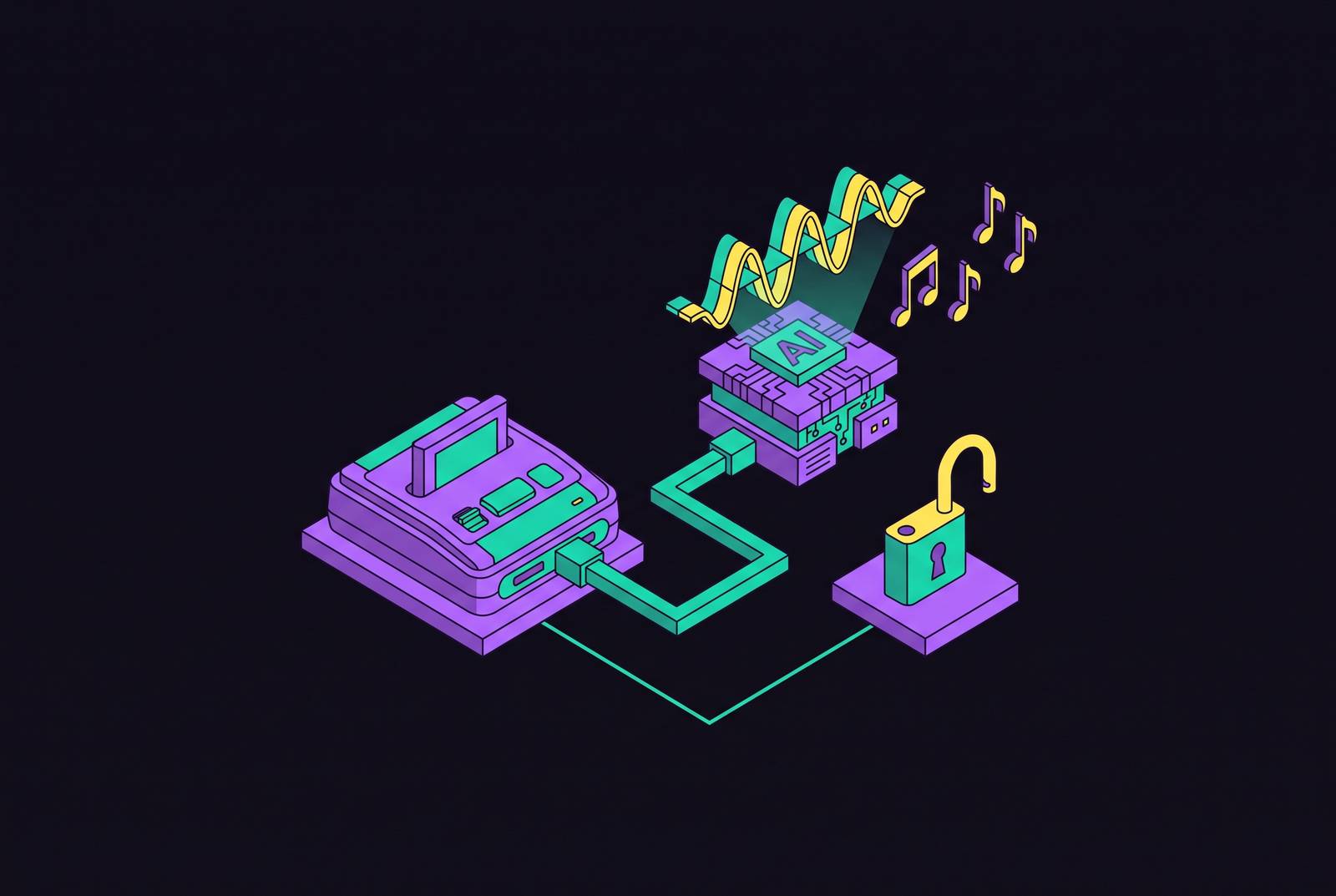
AI music generation for indie games is now a licensing and production problem more than an audio-quality problem. A commercially usable soundtrack starts with permission to distribute the music, then turns generated tracks into coherent loops and responsive cues. The soundest workflow puts those rights first and preserves the documentation needed to ship without avoidable royalty or disclosure problems.
Why AI music quality is no longer the bottleneck for indie game audio
Commissioning a composer puts costs beyond many solo developers’ budgets, while royalty-free libraries offer music that other games can draw from too. AI generation changes that tradeoff. It brings the cost of generating cues close to zero, reduces turnaround to hours, and lets developers describe music around a scene. Most major tools now produce audio good enough to ship. However, that progress leaves a more consequential gap between producing a convincing track and knowing whether its license permits distribution inside a commercial game.
Three licensing concepts that get conflated and why the confusion creates real risk
“Royalty-free” means that a track plays without a per-play fee, while ownership and training-data clearance remain separate questions. “Copyright-free” concerns copyright protection, while ownership concerns the rights a creator can actually hold. These distinctions govern different parts of the decision. A developer needs permission for commercial distribution even when it is unclear whether the generated material has copyright protection.
The U.S. Copyright Office has stated that copyright does not extend to purely AI-generated material or material with insufficient human control over its expressive elements. Prompts alone do not provide that control. A license to use a generated track therefore provides permission to distribute music without necessarily providing an ironclad copyright in it or exclusive rights that can keep others from using it, creating a competitive vulnerability as well as a legal distinction. Disclosure cannot supply that missing exclusivity.
Free access presents a separate contractual question. Free plans for the main tools usually allow only personal, non-commercial use of their output, though some have exceptions. A game sold to players, supported by ads, or offering paid DLC is commercial. The practical rule is to use a paid plan that grants the required rights or a permissively licensed open model, rather than infer permission from the ability to download a file.
How the main AI music tools sort by their actual commercial licensing posture
The useful division is between documented training-data licensing, commercial permission with unresolved litigation exposure, and permissively licensed open models. Those categories answer different questions. ElevenLabs Music offers licensed training data and commercial use on every plan. But its September 10, 2026 multi-year agreement with Universal Music Group is for a separate remix platform for fans. ElevenLabs has stated that no UMG catalog was used to train Music v2.5, so that agreement should not be mistaken for the model’s training provenance.
ACE-Step has open licensing. ACE-Step 1.5 uses MIT, while the original model has a different permissive license. Stable Audio 3 instead operates under the Stability AI Community License. Its outputs can be commercialized freely until a studio or its affiliates, individually or in aggregate, exceed $1 million in annual revenue from any source, when an Enterprise license applies.
Suno illustrates why commercial terms and litigation exposure need separate consideration. On September 9, 2026, it replaced its model line with the v6 family, comprising v6, v6-wild, and v6-mini, built with Warner Music Group, BMG, and Believe. Every older model, including v5.5, is being retired, so saved prompts and settings will not reproduce against those models. Suno’s terms also distinguish commercial-use rights from ownership. UMG settled with Udio in October 2025 and Warner settled with Suno in November 2025, but Sony has not settled with either, leaving its fair-use claims unresolved. For commercially shipped titles, the conservative recommendation is to keep both out of production pipelines until those claims resolve.
Treblo, formerly Sonauto, assigns output rights to users on every tier, including free, as of August 20, 2026, with unlimited generation and no download or streaming restriction. Muziko Pro is a low-cost paid commercial option, but its free-tier generations are not licensed for game distribution. Udio has a separate practical barrier, offering streaming, generation, editing, and remixing without export.
AIVA grants commercial rights on paid tiers and suits cinematic or orchestral scoring, although its output is static. Mubert provides royalty-free use by plan for continuous background streams, with stronger ambient and electronic uses than distinct themes. Soundraw uses an in-house licensed catalog and offers commercial rights for a monthly fee, with tempo and length editing suited to loops and menus. Google Lyria 3.5 provides full songs through the Gemini API with licensed training data and a SynthID watermark, but remains under developer preview terms.
What game music actually needs that a general music generator will not produce by default
A song that sounds complete in a playlist can still fail as a game cue. Loop structure is the first practical test. A restart that exposes an ending or fade becomes conspicuous when the player remains in a room or returns to it. To address that structure during generation, the prompt should specify “eight-bar loop, starts and ends on the same chord, no fade, can loop seamlessly”.
Adaptive scoring needs parts that can be controlled on their own, which a finished mix does not provide. An ambient base can establish the harmony, with a related generation adding combat percussion and brass over that foundation. The layers then support changes in intensity during play. But most general-purpose tools make finished tracks, and the ACE-Step Game Music Maker lists adaptive layers and stem export as coming soon. Those features should not be treated as available production dependencies.
Cutscenes require duration control as well as musical structure. An open-ended generation rarely lands on an exact scene length without an explicit duration in the prompt. Instrumental output also leaves space for dialogue, sound effects, and footsteps. Suno needs a prompt that asks for instrumental output when it would otherwise include vocals, while the Game Music Maker is built to make instrumental tracks.
Building a soundtrack brief before generating a single track
The soundtrack brief starts with a list of the situations that need music. For most indie games, that means a dozen or more cues spanning the main menu, exploration by biome, combat by zone, bosses, cutscenes, victory and defeat stings, and credits. Each serves a different gameplay function. Defining those functions first gives each generated track a place in the game, so the result goes beyond a set of tracks that sound good. It also identifies where a full theme is needed and where a background bed will suffice.
The next step is to define a shared sonic identity through a primary genre, secondary genre, instrument palette, and tonal mood. A base such as “modal folk with light electronics, fingerpicked acoustic guitar, soft synth pads” gives subsequent prompts a common vocabulary. Gameplay then determines how that vocabulary changes. Chiptune suits platformer levels and score-attack modes, while ambient lo-fi fits traversal, puzzles, and cozy games. The dynamic range of orchestral music works well for bosses and emotional story moments, while dark electronic or industrial music fits sci-fi combat and stealth, and suspenseful scoring works well for horror exploration.
Per-cue specifications turn that identity into a repeatable prompt template. Looping behavior, instrumental output, duration, key, BPM, and intensity define the cue’s production constraints without abandoning the shared palette. Consistency reduces wasted generation and stylistic drift. Developers using an established template report roughly half an hour to an hour per cue.
Implementing adaptive music in-engine once generation is done
Clip switching replaces one track with another, such as exploration giving way to combat, and suits hard changes in game state. Layering adds or removes parts within the same musical structure. Drums can enter as enemy count grows, while the base continues underneath. Generation supplies the source material, but the engine logic determines which of those responses the player hears.
That separation is essential when evaluating a generator’s output. A tool can deliver a convincing combat track without supplying the transitions or state logic that connect it to exploration. Similarly, related layers do not become adaptive merely because they share a prompt. The implementation must mix or crossfade them according to gameplay. AIVA’s static scoring illustrates this boundary, with track switching handled in middleware.
FMOD provides an authoring environment familiar to developers with a DAW background and supports more complex adaptive behavior. Its indie eligibility has financial conditions. It is free for studios below a revenue threshold, and a project must have a development budget under $600k to qualify for the indie license. Wwise is prominent in larger-budget productions but introduces more setup overhead for a solo developer. The choice therefore concerns the complexity of the musical behavior as well as the cost of authoring it.
What Steam and itch.io now require when you disclose AI-generated audio
Valve updated Steam’s AI disclosure form on January 16, 2026, replacing a binary checkbox with a two-tier classification system and adding requirements for live AI generation at runtime. Player-facing audio and music require disclosure. AI coding assistants and internal efficiency tools are exempt, so using an AI pair-programmer does not itself trigger disclosure when the shipped content contains no generated material. A release can be blocked if AI-generated content is tagged incorrectly.
By March 2026, more than 7,300 Steam games had disclosed AI content. Some developers report lower conversion after adding an “AI-assisted” label, although that response is not universal. Mislabeling instead risks removal. Hybrid production still needs care because an AI sketch, a cue edited heavily by hand, and a prototype left out of the final build are different uses. Planning for disclosure should start when production does, so the final submission matches what players get.
It is mandatory for asset creators and strongly encouraged for games. The platform prohibits content it cannot verify as yours, with enforcement operating through content matching. Developer reports from 2025–2026 identify AI-generated music resembling output from tools with unsettled litigation as a common false-positive category. Generation-session records and tool terms therefore provide useful provenance even where disclosure is encouraged.
A developer questioned about an audio asset needs something more concrete than a claim that the service described itself as royalty-free. Records of the plan and generation date help establish the applicable permission. A documented licensed training chain, such as ElevenLabs Music’s, also gives the developer a specific basis for explaining the tool choice.
A license-first workflow that takes a game's soundtrack from brief to shipped loop
The production sequence should begin by confirming commercial game distribution rights for the specific plan. The soundtrack brief then defines the cue inventory and shared sonic identity before generation starts. Each prompt translates that brief into musical constraints. Once generated, files need their intended loop behavior configured on import, followed by the switching or layering logic that makes playback respond to game state. A polished cue is both a musical asset and an implemented behavior.
The release record should preserve the plan tier, the terms in force at generation, and the generation date. Those records support provenance questions and accurate platform submissions.