AI Coding Assistants for Games Ranked by How Far Their Publishing Hand Actually Reaches
Ranking game AI tools by how far they take you toward a shipped game.
AI coding assistants for games should be ranked by how far they help a developer reach a shipped, ownable product. The right choice depends on which part of that path the developer still has to manage alone.
Why publishing reach, not code quality, is the right way to rank AI coding assistants for game developers
The assistant produces clean code, but the developer reaches export, disclosure, or platform submission and has to proceed without it. The code may be excellent. Yet the assistant cannot do the work that remains, even though that work decides whether anyone can download the game. That is the frustration conventional coding-assistant comparisons leave largely unexamined.
Code quality, IDE integration, language support, and suggestion speed measure useful capabilities, but they do not measure completion of a game. A game is shipped when a build is exported, platform requirements are met, and players can download and own it. Publishing reach thus measures how far along that path the tool can act on its own. It makes the hand-off visible.
The five rungs of publishing reach, defined
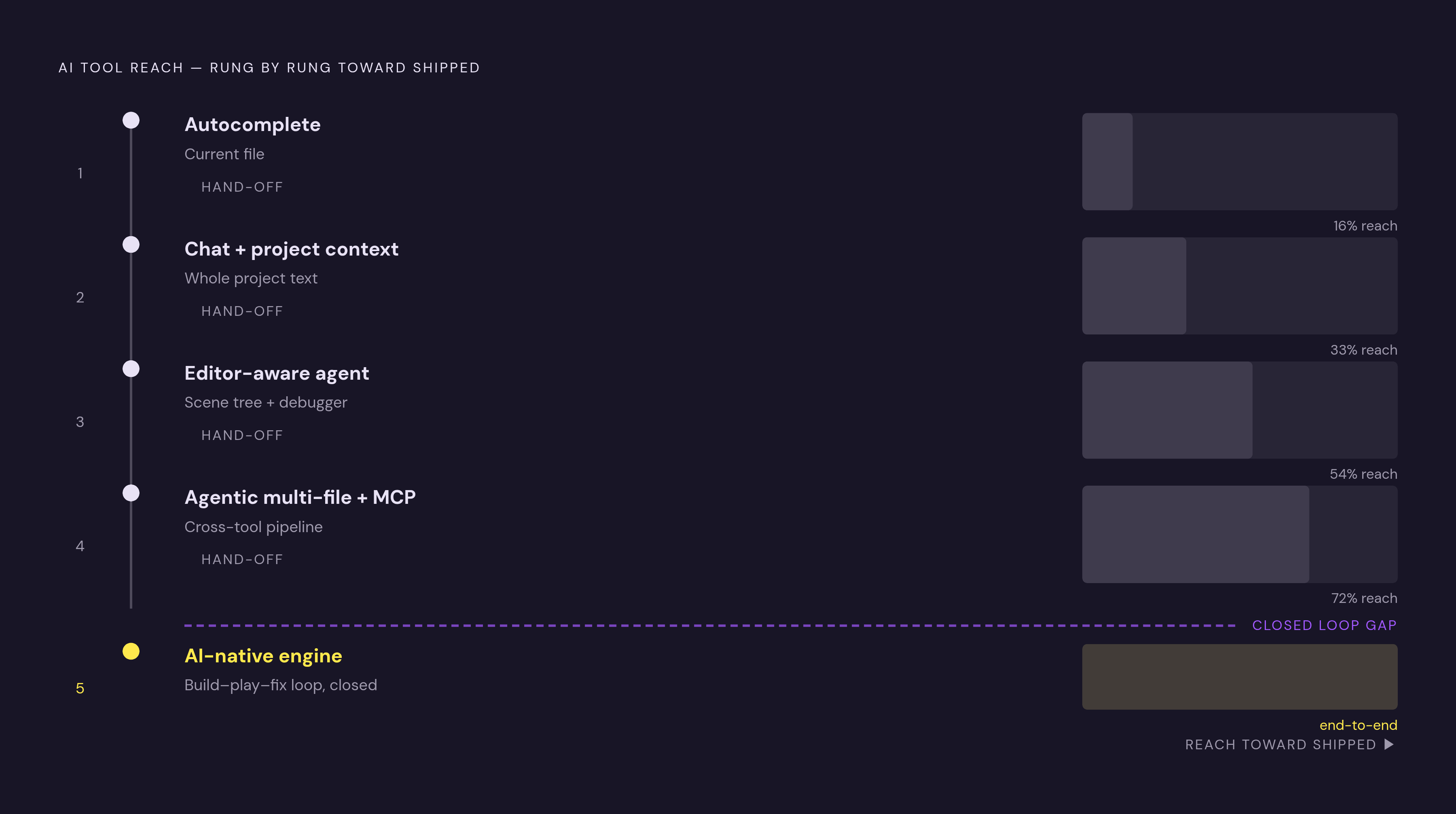
Rung 1 is autocomplete, which suggests lines or functions as the developer types in an existing editor. Its scope is the code being written. It has no awareness of project structure, scenes, or active errors.
Rung 2 is chat with project context, which reads project files and responds to questions about them. The developer still initiates the work. In this mode, the assistant does not act on the project itself.
Rung 3 is an editor-aware agent, which reads live editor state, including the scene tree, active errors, and debugger output. Its fixes have a different evidential basis. They respond to what the project is doing.
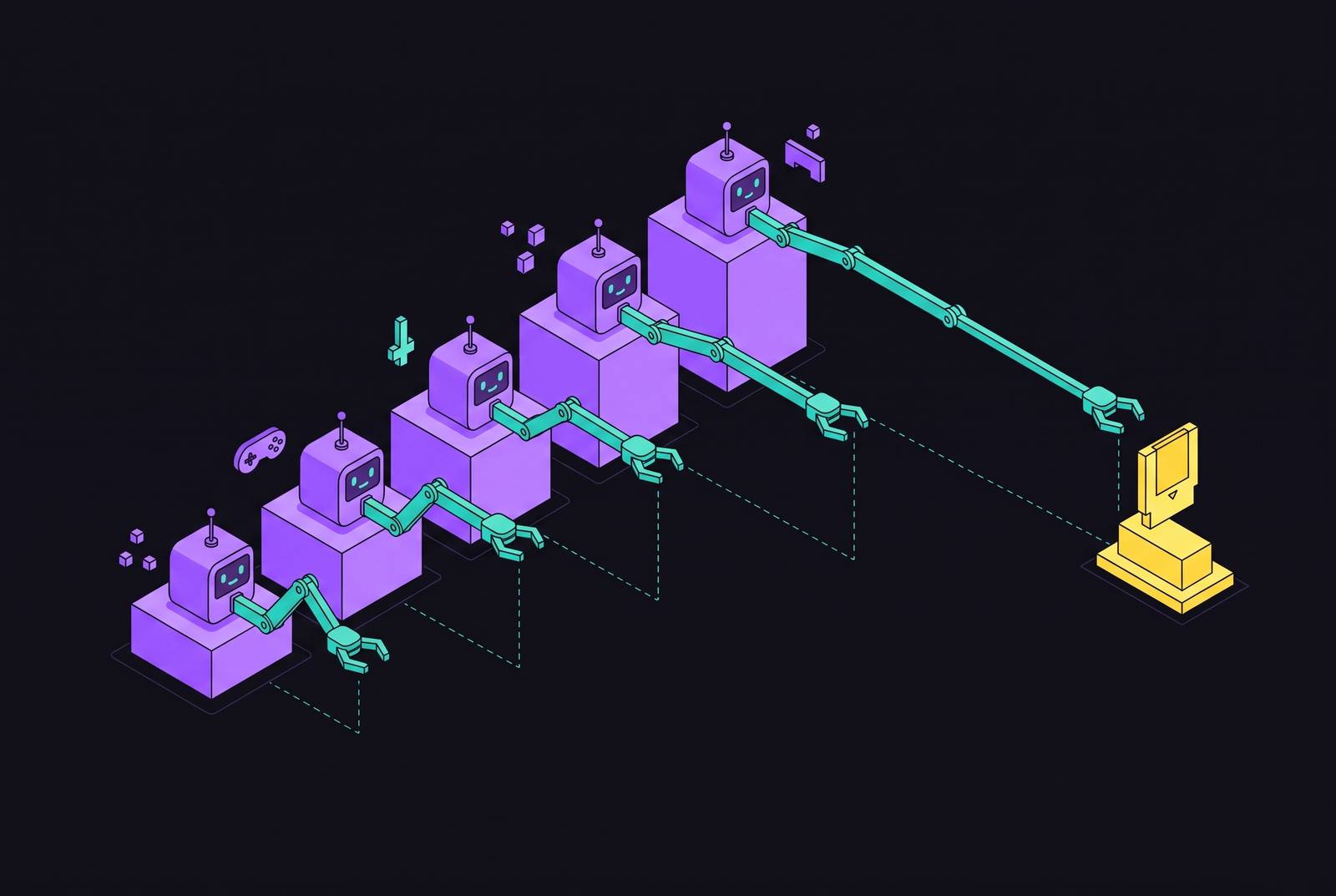
Rung 4 is agentic multi-file and multi-tool work, in which an assistant reads files, makes a plan, edits across the project, and runs shell commands. It can also chain tools through MCP. That expands its scope from answering questions to executing tasks across a pipeline.
Rung 5 is an AI-native engine, in which the AI runs the game, reads live runtime state, and closes the build–play–fix loop. Each step no longer needs a human intermediary. These rungs describe scope, so an excellent autocomplete tool can still occupy Rung 1.
Rung 1 — GitHub Copilot: strong suggestions, no view past the file
GitHub Copilot represents Rung 1 when used for inline completions. That is a useful, bounded role. It helps developers write code they already intend to write, within an editor and workflow they already use. For a practitioner who knows the project and wants less typing between decisions, this can be the appropriate level of assistance.
A completion-only configuration does not read the scene tree, inspect active errors, or act as an agent across the project. For engine-native code, that leaves important context outside its view, even when the suggested function is sound. Its publishing reach ends with help on code, so the developer still has to handle export, platform submission, and distribution.
Rung 2 — Cursor: whole-project context changes what the assistant can reason about
Cursor is a fork of VS Code with AI built into its core. Its project-wide context changes the questions it can answer. It can reason about cross-file dependencies, signal wiring, and architecture without the developer first explaining how the project is built. That is a category change from completing the file currently open.
A question about signal wiring is not confined to the function that receives the signal, just as an architectural question cannot be resolved from one isolated implementation. Reading the whole project gives the assistant a basis for connecting those pieces. The developer has less context to reconstruct manually.
In the Rung 2 mode considered here, Cursor remains a read-and-respond assistant, rather than an agent executing a task through the pipeline. Its view is limited to the project’s text, with running the game left to the developer in this workflow. Export remains a separate responsibility. The ranking applies specifically to this mode of use.
Rung 3 — Editor-aware agents: grounding fixes in what the project is actually doing
An editor-aware agent sees the project’s live state as well as its saved description. That distinction becomes sharpest when something breaks. Reading the active scene tree, running debugger errors, and physics state gives the assistant evidence that a file-based conversation cannot supply on its own. The developer no longer has to serve as the sole interpreter of that evidence.
For example, an agent that reads a debugger error can ground its fix in the reported failure. This closes a debugging loop inside the editor. Rung 3 connects the agent more deeply to the project’s behaviour while leaving export and distribution to the developer.
Rung 4 — Agentic multi-file tools with MCP: the pipeline expands but publishing still requires a human
Model Context Protocol connects external agents to creative tools so they can work across them. The gain is fewer manual hand-offs. Instead of answering a question about an asset or a file, the agent can create, move, and commit work across an asset-and-code pipeline.
The highest-leverage pattern combines Blender MCP, an engine MCP, Filesystem MCP, and Git MCP in one agent session. The agent can model a prop in Blender, export it to FBX, import it, place it in a level, commit to a feature branch, and push. The developer supervises the sequence.
Official MCP servers also connect agents to asset-generation services, including Ludo, Scenario, Meshy, PixelLab, Layer, Leonardo, Recraft, and ElevenLabs. That extends the session upstream into asset creation. A developer with an established stack can gain that continuity without replacing the core environment.
The external-agent model still has a hard boundary. In the Rung 4 workflow defined here, the agent does not press Play on the actual game and read live runtime errors from inside the engine. It also does not navigate platform-submission interfaces on the developer’s behalf. MCP expands the pipeline, but the agent remains outside the engine, and a human still executes the publishing step.
What the asset generation layer adds — and where it still hands the work back
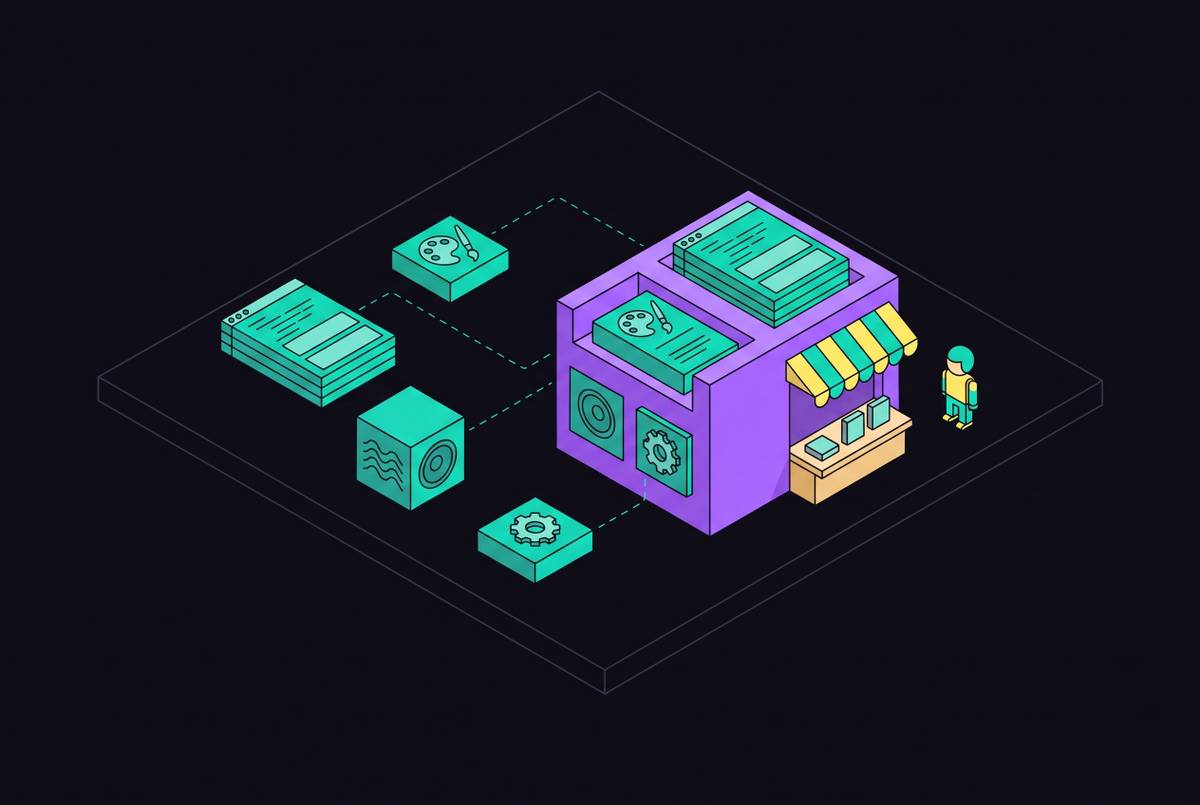
Asset generation expands what a solo developer can produce without a production team. That includes textured, rigged, animation-ready 3D assets, custom-trained 2D art styles, voice lines, and music tracks. The gain is substantial but incomplete. A generator delivers a file, while a game needs an asset that works within its particular scenes and systems.
Scenario supports custom-trained house styles so the 2D assets it generates can match the look already in use. ElevenLabs generates voices and is used more and more for sound effects, while Suno makes complete music tracks with vocals and lyrics from a prompt. Those outputs serve different production needs. Suno is not loop-focused, and AIVA, Mubert, and Soundraw compete for general indie game soundtrack work.
The hand-off is where “game-ready” needs qualification. A generated asset still has to be imported, correctly scaled, given the required collision behaviour, and made to animate in the game. A finished file is not finished integration. Unless the engine handles import and setup, the developer still has to do that work, even when the source material takes much less effort to make.
Rung 5 — AI-native engines: closing the loop Rung 4 cannot close
An AI-native engine changes how the engine is built, going beyond adding more external connections. The AI sees the full engine state, runs the game, reads the live runtime output, and fixes its own work. The feedback path stays inside the engine. A human does not have to relay each failure from the running game back to a separate assistant.
The defining capability is the complete build–play–fix loop. Pressing Play, reading the resulting runtime error, and correcting the output without human intervention joins actions that lower rungs leave separated. This is distinct from generating more code or chaining another tool.
Does closing that loop mean the developer gives up control? It does not require that trade-off. The AI can act as a collaborator within an engine the developer owns, with output the developer can inspect, modify, and export. For experienced practitioners, that distinction separates useful automation from a black box that restricts technical control.
Publishing capability still deserves its own scrutiny. Closing the runtime loop does not, on its own, establish that a system handles platform submission or distribution. The strongest publishing-reach case is an AI-native engine that also includes a publishing pipeline.
What Steam and itch.io actually require from AI-assisted games in 2026
Once a build is ready to export, platform requirements become a separate part of the workflow. Valve updated Steam’s AI disclosure form in January 2026 to make clear what it covers. The form focuses on content that ships with the game and is consumed by players.
Valve explicitly places AI-powered developer tools used for workflow efficiency, including code assistants and debugging software, outside that scope. The disclosure exclusion covers most uses of AI coding assistants but applies only to qualifying AI-generated outputs. Generated content that reaches players belongs to a different category from software that helps a developer write or debug code.
At this point, an assistant is useful if it helps the developer reach those release stages, going beyond another rewrite of the source.
How to choose the right rung for where you are in development
The developer should start with the work they still need help completing. Rung 1 suits someone with an established workflow who wants to move faster on code they were going to write anyway. Rungs 2 and 3 become more useful as a project moves from prototype to production and cross-file reasoning or live-error grounding begins to dominate the work.
A developer who already has a preferred tool stack should consider Rung 4 when manual transfers between those tools are the bottleneck. MCP can connect asset creation, engine work, and version control without changing the core environment. That preserves an existing production setup. It is a different proposition from adopting an AI-native engine to remove repeated intervention inside the build–play–fix loop.
Rung 5 becomes compelling for a solo developer or very small team whose goal is a shipped, ownable, distributable game and whose time is limited. To meet that goal, the system must have both that closed development loop and a publishing pipeline. Budget also enters the decision. Separate subscriptions for an IDE and asset generators bring costs and provider-management overhead, while a single subscription covering frontier models for code, art, audio, and video changes that calculation.