Game Engine Pricing Models and Hidden Costs for Indie Studios
Hidden fees in licensing, royalties, and post-launch costs often exceed the engine's sticker price.
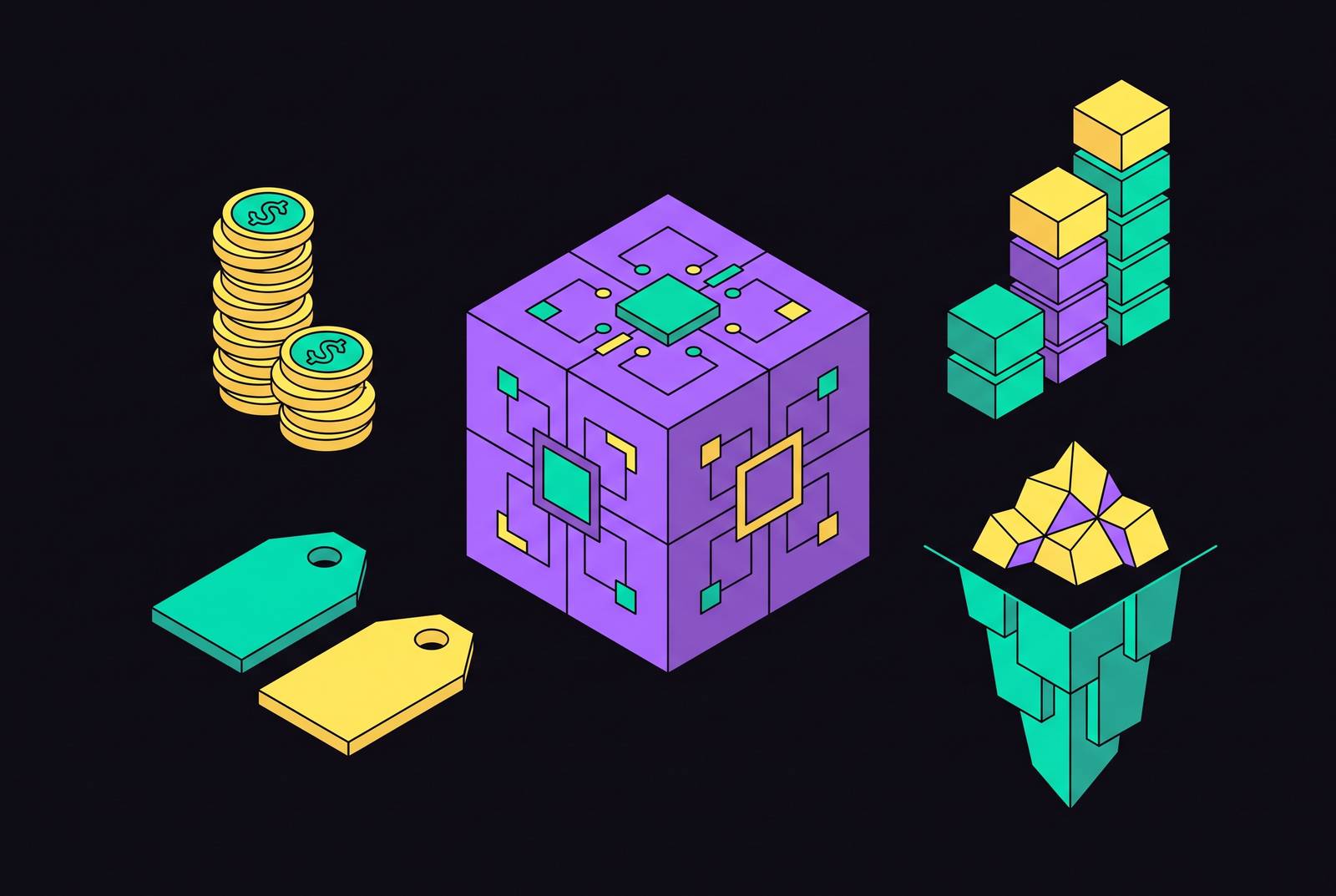
Indie developers typically research a single number before committing to an engine: the price on the landing page. That number, whether it describes a free tier, a one-time fee, or a monthly subscription, is only the first entry in a much longer ledger. What actually determines a studio's total cost runs through royalties collected once a game starts earning, licensing terms that can change mid-project, maintenance after launch, publishing fees charged at the moment of release, and a growing list of AI subscriptions that most budgets never account for. Most indie budgets are built around that single upfront figure and stop there, never modeling what happens when the game ships, when it sells, or when a vendor rewrites the terms a studio signed up for years earlier. The space between that narrow model and what a project actually costs over its life is where sustainable studios and struggling ones part ways.
Engine licensing structures and their costs at different revenue levels
Three licensing structures dominate the engine market, and each produces a different cost curve depending on how much money a game ends up making, not simply what it costs to build. With seat-based subscription licensing, you pay a fixed annual fee per developer, and it doesn't matter what the game earns. One major engine's Pro tier runs roughly $2,310 per seat per year, and a solo developer owes it whether the game earns nothing or clears a million dollars. The cost is predictable and front-loaded, scaling with the size of the team.
Royalty-on-revenue licensing works the opposite way. It costs nothing until a studio's game crosses a set revenue threshold, then it takes a percentage of gross revenue above that line. At the prototype stage, when most games never come close to that threshold, this model looks like the cheaper option by a wide margin. The math changes for the handful of games that do break through: a royalty that felt irrelevant during development can become a permanent tax on every dollar the game earns from that point forward.
With MIT open source licensing, revenue plays no role in the cost at any level. There are no royalties and no seat fees at any level of revenue, so the cost curve stays flat whether a game sells ten copies or ten million. The GDC 2026 report notes that newer indie developers adopt engines in this category at a higher rate, roughly 11%, than established studios do.
None of this makes one structure a clear winner on paper. The decision over royalties versus seat fees isn't purely a math problem: seat fees draw on money a developer already has in hand, while royalties draw on money the game might earn in the future. That distinction matters most for a studio self-funding its own build, where cash on hand and future revenue are not interchangeable.
The real cost of "free" engines: tooling, assets, and subscriptions
The engine license is rarely what costs an indie studio the most. Art, audio, tooling software, and AI subscriptions routinely add up to more than the engine fee itself, and that holds true regardless of which licensing model a studio picks. A zero-cost engine license can still sit inside a production pipeline that costs thousands of dollars a year to run.
Standard production software carries its own recurring costs that compound across a project's lifespan: design suites, 3D modeling and texture tools, audio middleware. None of it comes bundled with an engine license, free or otherwise. A year of paid creative software alone can add up to a meaningful annual overhead even on a lean indie project with a small team. Free alternatives exist, among them Krita, described on its own download page as free and open source, and Blender, which describes itself as a free and open source 3D creation suite. Both carry a real cost of their own in the form of a learning curve that a team already fluent in paid tools has to absorb before those savings appear.
AI tools have added an entirely new category of recurring expense on top of this. Voice generation, concept art generation, and code assistance each come with their own subscription tier, and each looks manageable on its own. Adopted without a budget, the combined total becomes significant. The strongest argument in favor of adding these tools anyway is that they compress the labor cost they replace: asset creation time shrinks, and that offsets the subscription cost. That offset is real only when a studio tracks both sides of the ledger. If a studio layers AI subscriptions on top of existing labor and freelance spend without cutting either, it never recovers the saving; it just adds a new bill.
This is where the structure of the engine itself starts to matter again. If an engine bundles its AI capabilities (code, art, audio) into a single subscription, it sidesteps the fragmentation that makes a separate AI stack expensive to track and manage. That consolidation is a real structural difference between an engine that builds AI in natively and one that requires a studio to assemble its own patchwork of tools from separate vendors.
Platform commission structures and publishing fees at the moment of launch
Launch brings a new category of mandatory cost, and it interacts directly with whatever royalty structure the engine already imposes. Steam charges a one-time submission fee per game, then takes a percentage of revenue, a percentage that drops at higher revenue thresholds most indie studios never reach. The standard cut applies to the overwhelming majority of indie titles, so the reduced tiers mostly benefit publishers who already clear revenue levels that few first-time studios approach. Studios releasing multiple smaller or shorter titles pay that per-game submission fee every single time, a real and accumulating cost for anyone shipping frequently.
Itch.io operates under different constraints. It does not support regional pricing the way Steam does, so prices stay flat globally, and that affects how much revenue a studio actually collects from players in lower-purchasing-power markets. That's a genuine tradeoff built into the platform, not a mark against it, and studios choosing between venues need to weigh it against whatever flexibility or terms itch.io offers in exchange.
Mobile platforms add a further layer. App store commissions sit on top of whatever royalty the engine already charges, and those commissions differ by store, region, and revenue band. Rates in some regions have shifted in recent years, so a studio planning a mobile launch needs to check the rate that actually applies to its target market rather than assuming one fixed number holds everywhere.
The compounding effect across all of this is easy to miss and expensive to discover late: a game built on a royalty-bearing engine, sold through a platform that also takes a commission, pays two separate percentage-of-revenue fees out of the same gross once it earns enough to trigger both. Most conversations about engine selection skip this math, treating the engine royalty and the platform cut as two charges drawn from the same dollar.
The post-launch cost phase that most indie budgets do not model before committing to an engine
Post-launch support isn't a one-time expense; it recurs for as long as the game stays live, and it starts the week the game ships whether or not the studio planned for it. A live title needs ongoing content updates, backend infrastructure, and community management every year, and that is not a discretionary investment, it is the baseline cost of keeping the product functional. Server costs start small right after launch, but they scale with concurrent players and recur every month, so that bill can catch a studio off guard if it budgeted carefully for the build phase but never priced out the operating phase.
Mobile titles feel this most acutely. Server costs, user acquisition spend, and ongoing maintenance combine into a post-launch overhead, and for any title that actually succeeds, it can exceed what the game cost to build. Success, in other words, creates its own cost structure, one separate from and often larger than the one the studio budgeted during development.
Engine choice shapes how expensive this phase turns out to be. An engine with restrictive export terms, platform lock-in, or deployment controlled entirely by the vendor adds migration risk for any studio that eventually needs to move its project elsewhere, and migration three years into a game's life costs far more than migration in month one, when the codebase is small and few systems depend on vendor-specific features. The strongest case for a licensing model with no lock-in isn't the money it saves upfront; it's the freedom to change post-launch infrastructure later without renegotiating terms or rebuilding the project from the ground up.
Localization updates, patch scripting, test generation, and asset pipeline maintenance are well-scoped, verifiable tasks, exactly the kind where agents perform reliably. Handing that work to an agent recovers real developer hours every week, hours that would otherwise sit inside the post-launch overhead a studio has to pay for out of pocket or out of its own team's time.
What policy-change risk costs, illustrated by MegaCrit's Slay the Spire 2 decision
A vendor's ability to change licensing terms after a project is already underway is a cost exposure that never appears in any upfront price comparison, and it can exceed every other cost event in this article combined. The mechanism is straightforward: a studio spends years building inside one engine's ecosystem, picks up dependencies on its specific tools and workflows, trains its team on its particular quirks, and ends up with a codebase that would cost enormously to move elsewhere. At that point, the vendor holds nearly all the pricing leverage over a studio that has nowhere practical left to go.
The 2023-2024 engine pricing controversy left behind a lesson that has nothing to do with the specific terms that were proposed or later withdrawn. Terms a studio believes are stable can change after the project is already committed, and the cost of migrating away is always highest at the exact moment a studio most needs to leave. The wave of studios that began evaluating alternative engines in the aftermath of that controversy is still reshaping market share today. The damage to trust in that moment has outlasted the specific terms that caused it, even after those terms were walked back.
MegaCrit's handling of Slay the Spire 2 shows what it looks like to build around that risk ahead of time. The game, developed by MegaCrit with a co-development studio, entered Early Access on March 5, 2026, for Linux, macOS, and Windows. It runs entirely on an engine with no royalties and no per-seat fees, and MegaCrit owns the codebase outright under MIT terms. Testing an engine under realistic conditions, in a smaller project or jam setting, before committing a full production to it, is the practical way to manage policy-change risk: it validates the engine's behavior at a scale small enough that moving away still costs little, well before the project reaches a size where migration becomes prohibitive.
The MIT license carries one specific structural protection that no proprietary license, however favorable its current terms look, can match: a studio can fork the engine, modify it, and ship those modifications without asking anyone's permission or renegotiating anything. That protection doesn't depend on a vendor's goodwill remaining constant. It holds regardless of what any single company decides to do with its pricing in the future.
Mapping the full cost sequence before committing to an engine
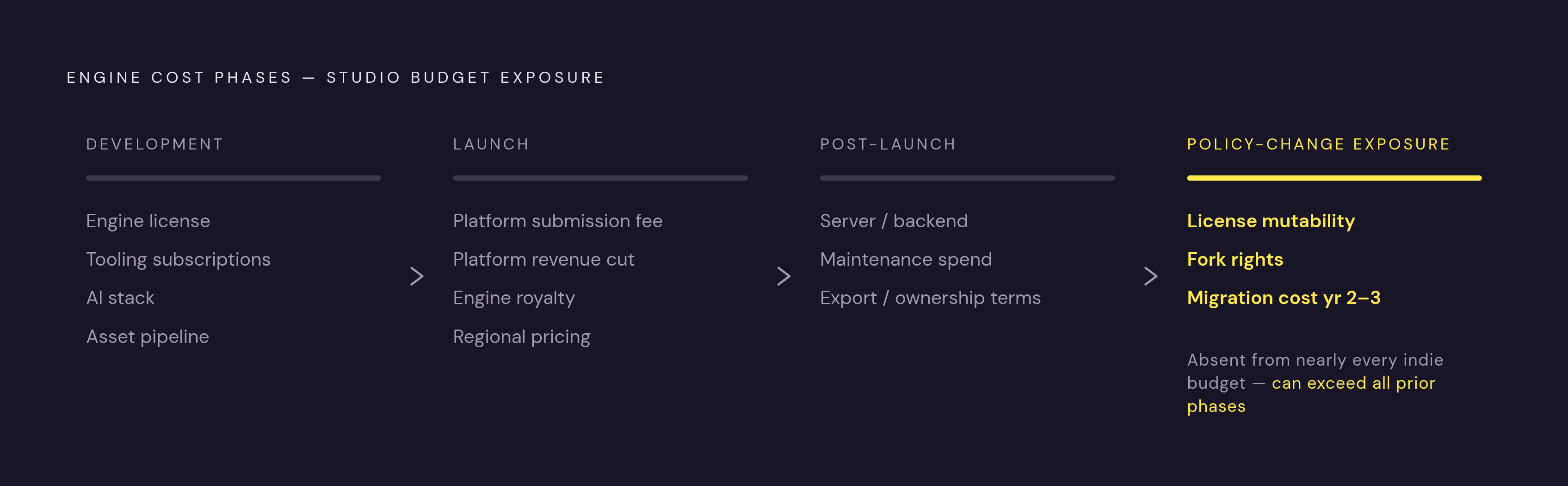
A defensible engine decision requires pricing out four distinct phases, development, launch, post-launch operation, and policy-change exposure, before signing on to any single licensing structure. Treating any one of these in isolation is how studios end up with budgets that look sound on paper and fall apart in year two.
The development phase checklist should cover the engine license cost at the team's current size, every tooling and software subscription the production pipeline requires, whether the AI tool stack is consolidated under one vendor or scattered across several, and the full asset pipeline cost, including any freelance work or generation spend layered on top.
The launch phase checklist should cover the publishing fee on each target platform, the revenue cut that platform applies, how any engine royalty interacts with that commission once a game earns past both thresholds, and whether the platform supports regional pricing for markets with lower purchasing power.
The post-launch phase checklist should cover expected server and backend costs at realistic concurrent player loads, maintenance spend as a fraction of what the original build cost, and whether the engine's export and ownership terms allow the studio to change its infrastructure later without asking a vendor's permission.
The policy-change exposure checklist should cover whether the license is contractually locked in or subject to the vendor's discretion, whether the codebase can be forked and maintained independently if the vendor's terms change, and what migration would realistically cost at year two or year three if that happens.
Integrated AI tooling changes this entire framework in one specific way. An engine that bundles code, art, audio, and the publishing pipeline under a single subscription removes an entire cost category, the fragmented AI tool stack described earlier, while also cutting into the labor hours that otherwise drive post-launch maintenance costs. That combination doesn't erase the four-phase accounting above; it changes the totals inside it. The full sequence has to be mapped before any engine is chosen.