What Built-In Generative AI Actually Means When Code Art and Sound Come From the Same Engine Session
Shared project context spares developers the manual stitching, but not the creative direction.
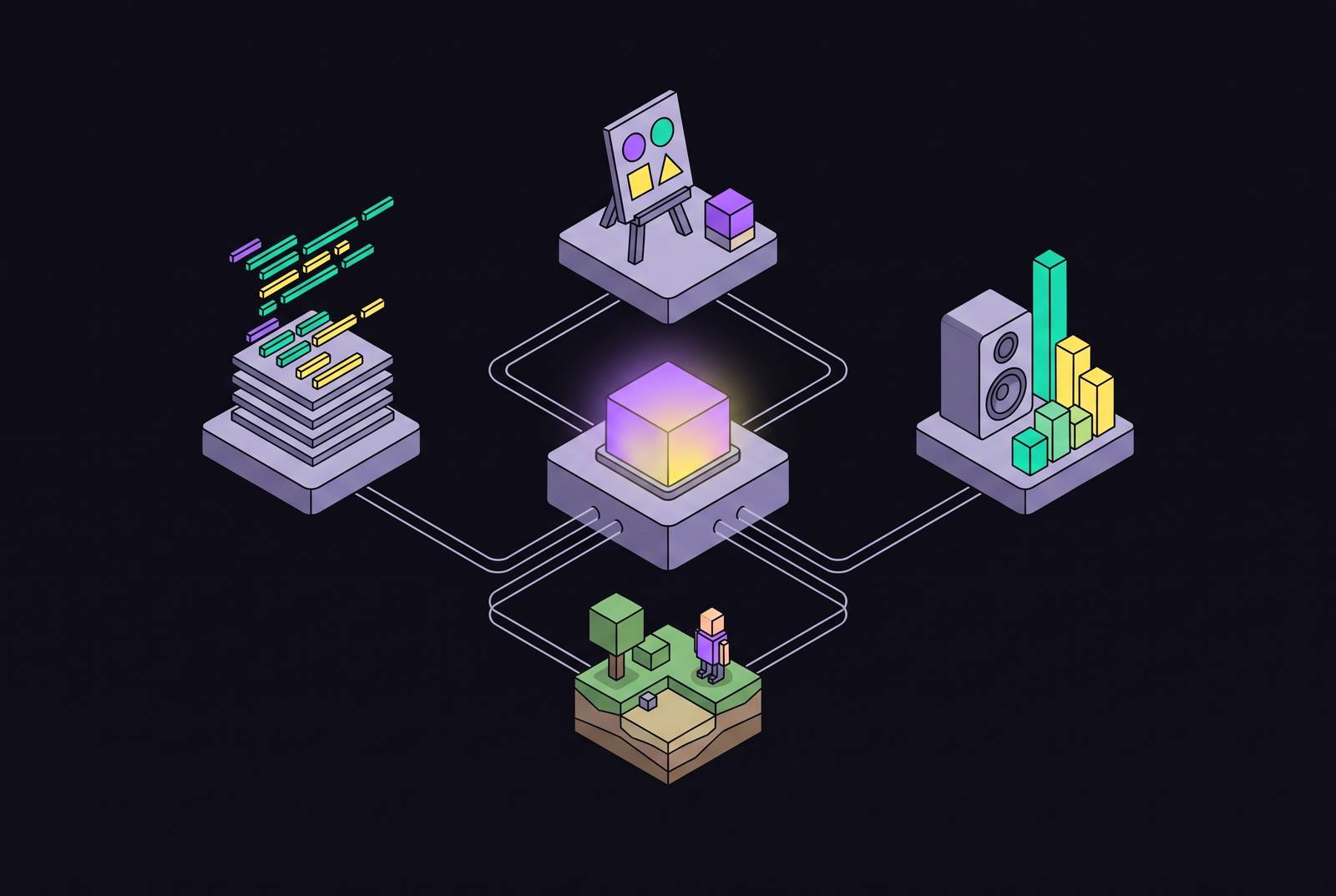
Built-in generative AI changes game development when code, art, and sound share the same engine session as well as the same interface. The distinction is shared project context. Each generation can use what is already there, so the developer can direct the game instead of making separate outputs fit together by hand. That integration changes the working conditions, but it does not supply a creative vision.
Why asset generation in separate tools creates a coordination problem
The developer has a finished character image, a music loop, and a movement script, but none has a shared reference point. The code assistant cannot see the character design. The image generator cannot reference the music palette, while the audio tool knows only the description entered into its prompt. Each output may work well on its own. Together, they still require someone to establish how they belong in the same game.
That work falls to the developer because game development combines code, art, audio, and scene assembly, each with distinct tooling. Moving between generators means exporting assets, reformatting them, and repeating decisions already made elsewhere. The human becomes the integration layer for the stack. Disciplined sequencing can reduce drift, but it does not give one tool access to another tool’s context. It makes the handoffs more orderly while leaving the developer responsible for reconstructing the project at every boundary.
What "session-level context" means and why it changes what the AI can do
Session-level context means the AI has a running model of the project. The scene tree, character controller, existing sprites, and tempo of a placed music loop are available as references for subsequent work. The developer can refer to the game already under construction instead of restating its genre, character names, visual style, and tone.
The difference depends on access to the live project. An agent can read the scene hierarchy, inspect assets, run the build, and read debug output. For the developer, this changes the conversation from describing what probably exists to directing changes to what actually exists. A new request can build on earlier decisions because those decisions are present in the scene and its assets.
This is a broader benefit than remembering a conversation. A description of a character is not the same reference as the character’s placed sprite and attached controller. Access to both gives the AI grounds for reasoning about whether a new output fits. Yet shared context is not shared style. Knowing the project makes consistency possible to assess, but it does not guarantee that every generation will preserve the intended identity.
How the code layer behaves differently when it can see the art and scene that already exist
The familiar failure appears when generated code reaches the editor and its node names do not match the scene. A separate chat model has written a script that looks right using names and physics body types it has assumed. The developer then reconciles those assumptions with the actual project. The code may be sound in isolation. Its references and setup still need to be fixed before it can work in the game.
An agent operating inside the project can work on that setup directly. It creates the character body, writes and attaches the movement script, sets collision layers, binds input, and runs the game. There is no separate paste-and-wire stage for the developer. When the character sprite is already generated and placed, the movement code can reference its actual dimensions and physics body. The script and the scene are parts of the same task.
That access also supports a more controlled development rhythm. Each mechanic can be added separately and tested immediately, keeping a failure close to the change that introduced it. The bug has one suspect rather than ten. Debug output then gives the agent evidence from the running project instead of a hypothetical account of what might have gone wrong. Scripts take less time to write, and the path from a request for a behavior to a tested mechanic is shorter.
How art generation changes when the AI already knows the game it is dressing
A new sprite has to fit a scene. Tile size, camera projection, the existing palette, and the character already placed all constrain what will work. In a disconnected workflow, the developer must convey those constraints again. Inside the session, they are available as references. Art can be generated, positioned, scaled, and placed against the project it is meant to inhabit.
This removes a class of sizing and format errors that otherwise emerge only at import time. It also changes how the style description is used. The developer describes the intended style once, and later generations can use that description without the developer having to write it again for every asset. Existing art gives that description a concrete reference.
Ternar et al.’s Generative AI in Game Development: A Qualitative Research Synthesis reports that around 60% of disclosed implementations involve visual asset generation. Session integration addresses the handoff between those generated images and their use in a scene. Choosing the game’s visual identity remains a human decision, even when the AI can execute that choice without a separate import workflow.
How audio generation fits into a session that already has a game running
Audio from outside the project often arrives after the game’s pacing is already set. The developer describes the genre and mood in a music tool, downloads a loop, and imports it. Only then does the conflict become audible. A track that fits the written description may not fit the rhythm of the game in play, so it needs another change before it can be used.
Inside the session, a request for audio can refer to the game loop, character actions, and scene environment that are already there. The prompt inherits the established genre, tone, and character vocabulary. That is a specific and useful advantage. A background score or sound effect is requested against the running game rather than a description reconstructed from memory in another tab. Audio enters the same context that informed the code and art.
Sound effects can fit the game less well than environmental music, and synchronization and triggering remain concerns beyond the generation of a clip. Context alone does not resolve those problems. The narrow claim is that the audio prompt starts better informed and its output can be considered within the existing session. Whether the result fits the pacing and mood remains a creative judgment.
The coherence problem that session integration does not solve automatically
Independent prompts can produce an incoherent game even when they share a session. An art request can depart from the established style, a sound effect can conflict with the music palette, and a new mechanic can contradict existing rules. The AI may know what has been built without maintaining a consistent creative vision. These are different kinds of knowledge. Project access supplies references, but it does not decide which references should govern when a request pulls in another direction.
The developer should be treated as the session’s director. That role includes deciding the style, naming it precisely, and maintaining it across prompts rather than inventing a new direction for every asset. Inherited context reduces the need to re-enter technical facts. Even with that context, the developer still has to be clear and consistent about what they want and judge whether an output fits.
This distinction also locates the benefit more accurately. Node names, asset formats, physics bodies, and the established palette no longer need to be manually reconstructed at each tool boundary. Attention can move from those handoffs to the relationship between mechanics, appearance, and sound. The human remains responsible for the game’s identity while the system can perform more of the mechanical work that connects its parts.
What a complete session looks like from first prompt to exportable build
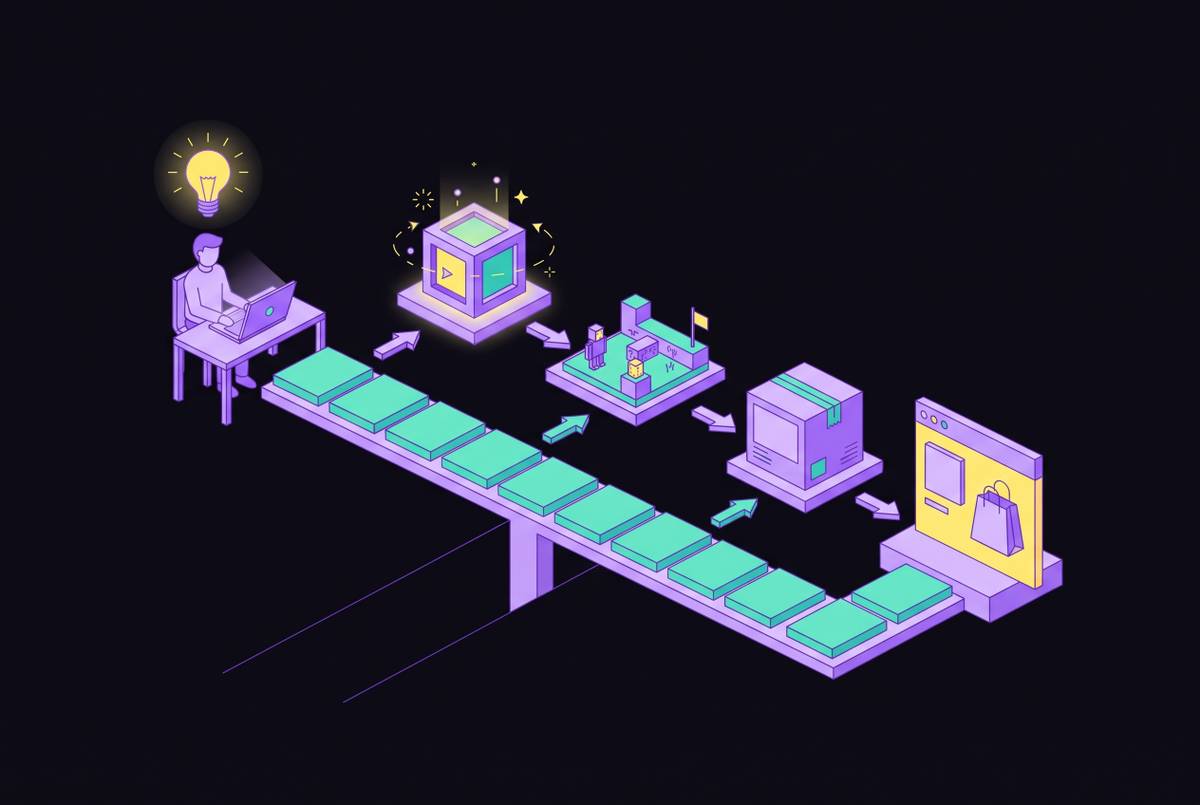
A complete session begins with a compact statement of the game, naming a player, an action, and a win/loss condition in one sentence. That statement anchors the requests that follow. The developer then starts from a template that matches the genre, giving the project its foundational physics, input, and scene structure. The AI can spend its effort on what makes the game specific. The creative premise now has a project in which to take shape.
The developer prompts the core loop and presses play before adding another layer. The test establishes whether the requested behavior actually works. One prompt, one test, and one observation keep the next decision grounded in the running build. If something fails, the agent can read the debug output and fix an actual error.
Once the loop works, art, sound, and music enter that same session. The developer names the visual style and directs subsequent assets against it, while the AI uses the scene’s existing references to generate and place them. Requests for audio refer to the running game and the tone it already has. No separate import pipeline interrupts those handoffs. The developer judges how the layers work together, directing changes in appearance or sound without taking over the wiring between them.
The endpoint is an exportable build owned by the developer, capable of publication to real storefronts. The project file preserves the work accumulated through the session. It is not merely a conversation that disappears after producing a demonstration.
Why the session boundary is where engine design decisions get made, not marketing ones
Putting AI inside or outside the session determines who performs the integration work. An assistant outside the session can speed up each task while still giving the developer outputs to put together. An agent inside the session can work across the project that those tasks change. A shared interface alone says little about whether generated code, art, and sound can draw on the same live state.
The synthesis frames the broader shift as a change to production pipelines and value networks. Whether the AI can access the scene tree, existing assets, and debug output or receives only descriptions typed into a separate window matters. Output quality remains relevant, but it is not the whole decision. The architecture determines how much work remains between a useful generation and its place in the project.
The work described here depends on access to the live project, context shared across asset layers, and a project that can be exported. They allow creative decisions to accumulate without repeated manual reconstruction. The final choice remains the developer’s to make. An engine earns its place when its design lets the developer spend more of the production cycle deciding what the game should become, and less of it reconnecting decisions already made.