From Zero Coding Knowledge to a Steam Product Page You Actually Own
A non-coder's staged path from prototype to a sellable Steam game.
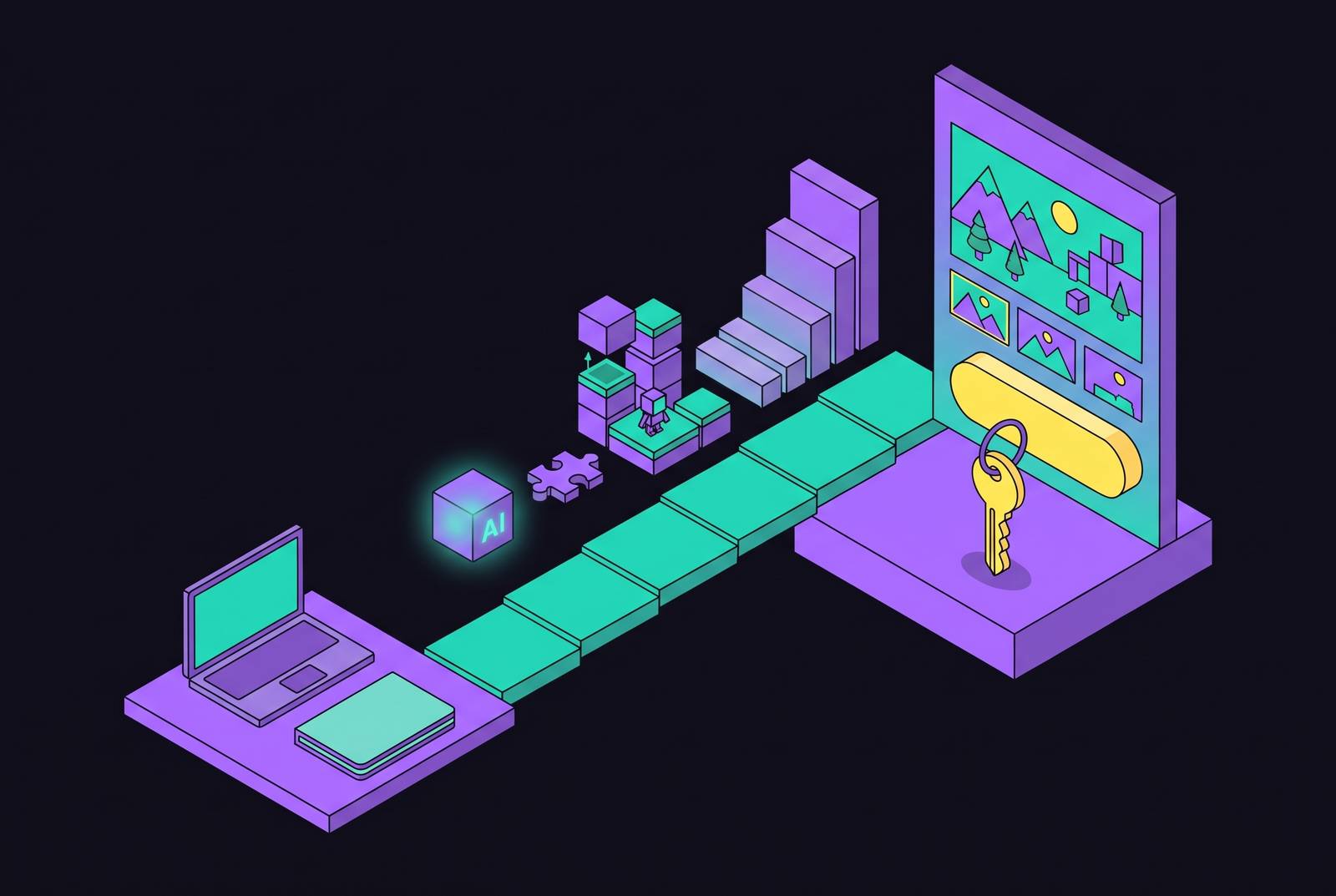
The path from zero coding knowledge to a Steam product page is now practical, but generating a prototype is only its first phase. Finishing requires a controlled sequence of scoping, building, testing, listing, and audience development. Ownership adds a further condition. The tools must produce an exportable game that you have the rights to distribute and sell, rather than a playable result confined to someone else’s platform.
Why the gap between "game idea" and "Steam product page" is finally closable — and what still closes it
Most guides show one impressive prompt and stop. They leave out the second hour, when a change breaks something, the prototype needs coherent assets, and the creator must decide what to build next.
Three developments have made that sequence more accessible. AI coding assistants can turn plain language into working game code, game-focused asset generators now make assets good enough to use in a finished game, and AI agents can work inside editors. The last development removes a substantial handoff. A separate chat assistant supplies files that you must assemble, while an editor-integrated agent can build scenes, attach scripts, configure physics, and produce something ready to play.
What AI actually carries and what you still have to drive
AI accelerates prototyping, code scaffolding, and asset generation. It does not compress design decisions, gameplay tuning, or the judgment of whether a game is enjoyable enough to release. A useful planning approximation is that AI reaches roughly the first sixty percent quickly, reducing months of initial construction to days. The remaining work takes a different kind of attention. Feel, balance, polish, and playtesting can still consume most of the schedule.
The practical allocation is to use AI for boilerplate, initial code, and asset production while reserving human judgment for gameplay feel and narrative coherence. Coding knowledge is not a prerequisite for these workflows. Knowing how scenes, nodes, and the core loop work does help you describe changes and spot results that are wrong. Once that division of labor is clear, the building phases can move at a pace unavailable two years ago.
Scoping the idea before touching any tool
Scope sprawl is the biggest risk in an AI-assisted project because cheaper building makes it tempting to add more features. A project can become unfinishable before its basic interaction is satisfying. The starting sentence should contain three parts, namely the player, the action, and the condition that ends a round. A platformer, for example, can consist of a player jumping between platforms, collecting coins, and losing by falling off the bottom. That is a playable target.
Story, art style, menus, sound, and additional levels come later. An open-world RPG with crafting, dialogue, a day-night cycle, and three factions gives the assistant no comparably small starting point. Genre provides a useful scope signal here. Text adventures, arcade clones, card games, and simple puzzles are appropriate first projects, while platformers with substantial level design and tower defense involve more work. Open-world and multiplayer ambitions belong in a later project.
Starting from a template instead of a blank project
Once the loop is defined, a genre-matched template supplies foundational systems that are already correct and tested. A platformer template comes with the character controller, gravity, jump tuning, and tile collision. A survivors-like template supplies auto-attack, enemy spawning, and the level-up loop. AI effort can go toward the changes that distinguish the game.
The same principle applies beyond action games. RPG templates handle stats, inventory, and combat variants, while simulation templates cover growth timers, day cycles, and resource systems. Puzzle templates provide grids, input handling, and win-state checking. With that foundation, a first request can change a character into a wizard or replace coins with mana crystals. Small, specific changes give the assistant a clearer target than building an entire genre from nothing.
Prompting the core loop and testing it immediately
Prompt one change, press play, observe, and only then request the next change. Begin with “Add a double jump.” Play the result before proceeding to “Make enemies drop a coin when killed.” Test that behavior before adding a health bar that falls when the player touches an enemy. Finally, ask for a game-over screen with a restart button when health reaches zero, and test that the game switches to that screen too.
Each request creates a single inspection point. If a newly introduced behavior fails, the latest change is the immediate suspect, sparing you the task of sorting through ten untested additions. This rhythm can produce a real game in an afternoon without requiring a single large leap that is difficult to inspect. An agent inside the editor also has a practical advantage over a separate chat assistant. It can read runtime errors and correct against the running project rather than rely on your description of what went wrong.
Generating assets inside the same workflow
Once the loop runs, asset generation follows the same incremental discipline. AI can make visuals, audio, and music, but you still choose the art direction and judge whether each result fits. Decide the style and describe it precisely. Generated assets are a strong first pass.
Meshy covers a 3D pipeline from text or image input through PBR textures, auto-rigging, and animation presets. A person may need to rework its auto-generated topology for hero characters or complex rigs. Its free assets use CC BY 4.0 and require attribution, while assets stay private on paid plans from Starter upward. Scenario meets a different need with custom-trained models that use reference art to make sprites and tiles that share the same style. Paid plans are available.
Suno generates music from prompts, while ElevenLabs covers voice and sound effects. Both have free tiers that limit how much they can be used and licensing terms that need to be checked before a commercial release. ElevenLabs grants commercial licensing on paid tiers. Document the appropriate license for every commercial asset. A usable file and permission to sell it are separate requirements.
What MCP integration actually changes about this workflow
The Model Context Protocol, or MCP, is a standard that lets AI agents access multiple tools from one environment. In a game-development workflow, an agent can write code, build scenes, generate assets, and run the project without requiring you to move between separate windows. The benefit is continuity across production tasks.
Anthropic open-sourced MCP on November 25, 2024. By mid-2026, Claude, Cursor, Windsurf, OpenAI, and others had adopted it, with governance under the Linux Foundation. Those developments establish a shared connection standard, but the practical value comes from the tools connected to the agent. Access to the editor and debugger grounds corrections in actual project behavior. For a non-technical creator, that reduces the manual handoff between asking for a change and finding out whether it works.
The GDScript pitfalls that catch AI-assisted creators off guard
Version drift is a common failure in AI-generated GDScript. An assistant may mix older patterns into a newer project, using incompatible method names, node types, signal syntax, or API calls. A single obsolete call can break a longer script. Specify the exact project version and GDScript in every coding prompt so the assistant has an explicit compatibility target.
Language drift creates a related problem. GitHub Copilot can suggest patterns borrowed from Python, JavaScript, or C# that do not apply in GDScript. When a script fails, return the full error message to the assistant. An agent operating inside the editor can read runtime and debugger errors directly and catch most of these problems automatically.
Playtesting as the phase AI genuinely cannot do
A game that runs has passed a technical test. AI can build the scaffold and connect its systems, but judging the loop’s lasting appeal after the first few minutes is beyond its capabilities. That judgment belongs to people playing the game. Their reactions expose difficulty that rises too quickly, controls that feel wrong, and moments of confusion or boredom that produce no runtime error.
This is where the creator’s judgment becomes decisive. Put the game in front of real people before it feels ready, listen to what their play reveals, and revise it. Early testing can discard weak ideas while they are still inexpensive to change. Testing late can uncover the same flaws after much of the work has been built on them. Budget explicitly for polish because it is a development phase.
What Steam actually requires before you can publish
Steam Direct is self-service, with no invitation system or vote-based approval. Individuals can publish without forming a company. The process requires a legal name, a W-9 or W-8BEN tax form, a bank account, identity and tax verification, and technical review. Tax and bank verification can take weeks, so they belong in the release schedule.
The financial plan must include a flat Steam Direct fee per game, refunded after a revenue threshold is reached. Valve also takes a standard revenue percentage that drops after a high-revenue milestone. The reviews of the store and the build each take up to several days. The Coming Soon page must stay public for at least 2 weeks before release.
The store page needs a short description within its length limit, a long description, and tags. Avoid using “Indie” or “Singleplayer” as primary tags because they provide little signal about the intended audience. The build has a separate, decisive requirement. Steam does not accept web games, so the game must run as a standalone application. Complete the AI disclosure field factually and retain documentation for asset licenses, treating disclosure as part of the submission process.
Building a wishlist before you need it
The Coming Soon page begins the work of finding an audience while the publishing process is still underway. Wishlists are a primary lever for Steam’s launch visibility, so a technically complete submission does not substitute for an interested audience. Treat wishlist accumulation as a development phase.
As planning references with no guaranteed outcome, the benchmarks often cited suggest that a game needs thousands of wishlists for a realistic chance at Popular Upcoming and 30,000+ for a buffer at a mid-tier indie launch. For a creator without an established audience, the practical tools are a gameplay trailer with something visually distinctive early, a short description that identifies the experience clearly, and participation in communities where the intended players already spend time.
Game jams give that presentation a test within a set time. Jamference’s AI Game Jam Hack 4 runs November 13–20, 2026, on itch.io, within a series running every two weeks. Its focus is making games with AI in the open. A playable submission can function as a soft launch, attracting players who may become wishlisters before the Steam release.
Owning what you ship — exports, publishing rights, and what "your game" actually means
Ownership requires more than access to a playable URL. In practical terms, the tool must let you export a standalone executable for the intended platform, including Windows, macOS, Linux, iOS, or Android. You must also be able to publish through Steam, itch.io, or mobile app stores without seeking permission from the creation tool.
Rights to the game are a separate requirement. You must retain the right to sell it and keep revenue after platform cuts, with documented commercial licenses for its generated art, audio, music, and voice. Before choosing a tool, establish whether it exports standalone builds, whether you own its output, and whether distribution is gated. These questions belong before production because they determine what the finished work can become.
With those conditions satisfied, the full sequence is available to someone with an idea and no coding background. Scope the loop, build in tested increments, put the game before players, prepare the listing, develop a wishlist, and ship. You end up with a real game that you can export, distribute, and sell.