Why Your Godot 4 AI Copilot Needs Version-Drift Resistance Not Just Autocomplete
Godot 4 assistants need version awareness and engine feedback, not just speed.

A Godot-compatible AI coding assistant for GDScript needs autocomplete with version-drift resistance. The useful distinction is whether it knows the exact Godot 4 version, reads the project’s scene structure, and corrects code against engine feedback. Without those safeguards, faster generation can cost more debugging time than it saves.
Why autocomplete alone fails Godot developers
A developer installs Copilot expecting an intelligent Godot collaborator and gets a fast but version-blind typist. Line-by-line GDScript suggestions can reduce typing, but they do not establish whether the project compiles, runs, or uses the right API version. Those are separate tests. An autocomplete-only tool is “a reliable typing partner, not a project-aware agent” because its useful output stops short of verified integration.
That gap changes the meaning of productivity. A suggestion saves time only if accepting it does not create more work elsewhere in the project. In Godot, that work includes fixing node references, wiring signals, and finding API calls from another engine version. The relevant standard is therefore not how quickly an assistant completes a script, but how much unchecked integration work it leaves behind.
How Godot 3 contamination is baked into every general-purpose model
A decade of Godot 3 tutorials on the public internet creates a data-distribution problem by giving general-purpose models plenty of old patterns to draw on. Those older examples can shape the code even when the request names Godot 4, and fine-tuning does not wipe out their influence. A stronger model drifts less often. It does not become immune.
The substitutions are recognizable to experienced Godot developers. Generated scripts use yield instead of await, or reach for KinematicBody and KinematicBody2D rather than Godot 4’s CharacterBody2D and CharacterBody3D. They also produce the obsolete forms export var and onready var, whose current equivalents are @export var and @onready var.
The contamination extends beyond individual keywords. A model can treat a Godot 3 Tween as a child node, overlooking the current approach of using create_tween() in code. It can also emit the obsolete form connect("pressed", self, "_on_pressed"), whose current equivalent is button.pressed.connect(_on_pressed). To a reader unfamiliar with the migration, those obsolete lines look plausible. Plausibility gives the developer no assurance of compatibility. Drift requires a checking mechanism outside the model’s initial answer.
Why drift compounds across Godot 4 minor releases
Specifying Godot 4 removes only the broadest ambiguity. The assistant must still distinguish the API and behavior of one minor release from another. The official Godot upgrade guides list breaking changes for every minor release from 4.0 through 4.4 and include a GDScript compatibility column. Compatibility is therefore not a one-time migration concern. It recurs as the project moves through the release series.
The 4.8 beta illustrates how specific those differences become. It forbids scripts from inheriting their own inner classes and warns when strings are used as comments, with the latter producing a nonfatal standalone-expression warning. The.NET build now requires.NET 10 or newer, up from.NET 8, among the changes a model trained through mid-2026 would miss. A general instruction to “use Godot 4” cannot supply information absent from its training.
Benchmark results introduce a further version gap. The GameDevBench leaderboard’s October 9, 2026 snapshot benchmarks on Godot 4.4.1, while a 2026 Godot community poll found that 63.8% of respondents mainly use 4.7. A score on the former does not establish compatibility with the latter. For a developer assessing assistants, this is a concrete limitation on what a ranking proves.
Who pays the highest price when drift goes undetected
Experienced developers have a diagnostic shortcut that newcomers lack. Seeing KinematicBody immediately identifies a Godot 3 relic, narrowing the search before debugging begins. A first-time indie developer may spend hours investigating the same failure without knowing that version history is relevant. Time-constrained and non-technical creators have the least slack to absorb that hidden integration work.
Game jams make the cost especially concrete. A 48-hour window leaves little room to diagnose a move_and_slide() signature change or a signal connection written in Godot 3 string style. Slapjam #3 is a free online AI game jam on itch.io for mobile-portrait browser games, set for November 28–30, 2026, with a cash prize pool. It exemplifies the time-boxed environment in which drift bugs can prevent a submission.
Yet a crash is not the most deceptive outcome. Godot 3-style signal connections that connect twice can cause double-fire bugs that look like physics problems, while code that assumes node references are ready before _ready() can fail silently at runtime. Such behavior directs debugging toward symptoms and obscures the version mismatch. Generated code compiles more often than it is correct. Consequently, “it ran without errors” is too weak a quality signal for an assistant’s work.
The four-tier architecture of drift resistance
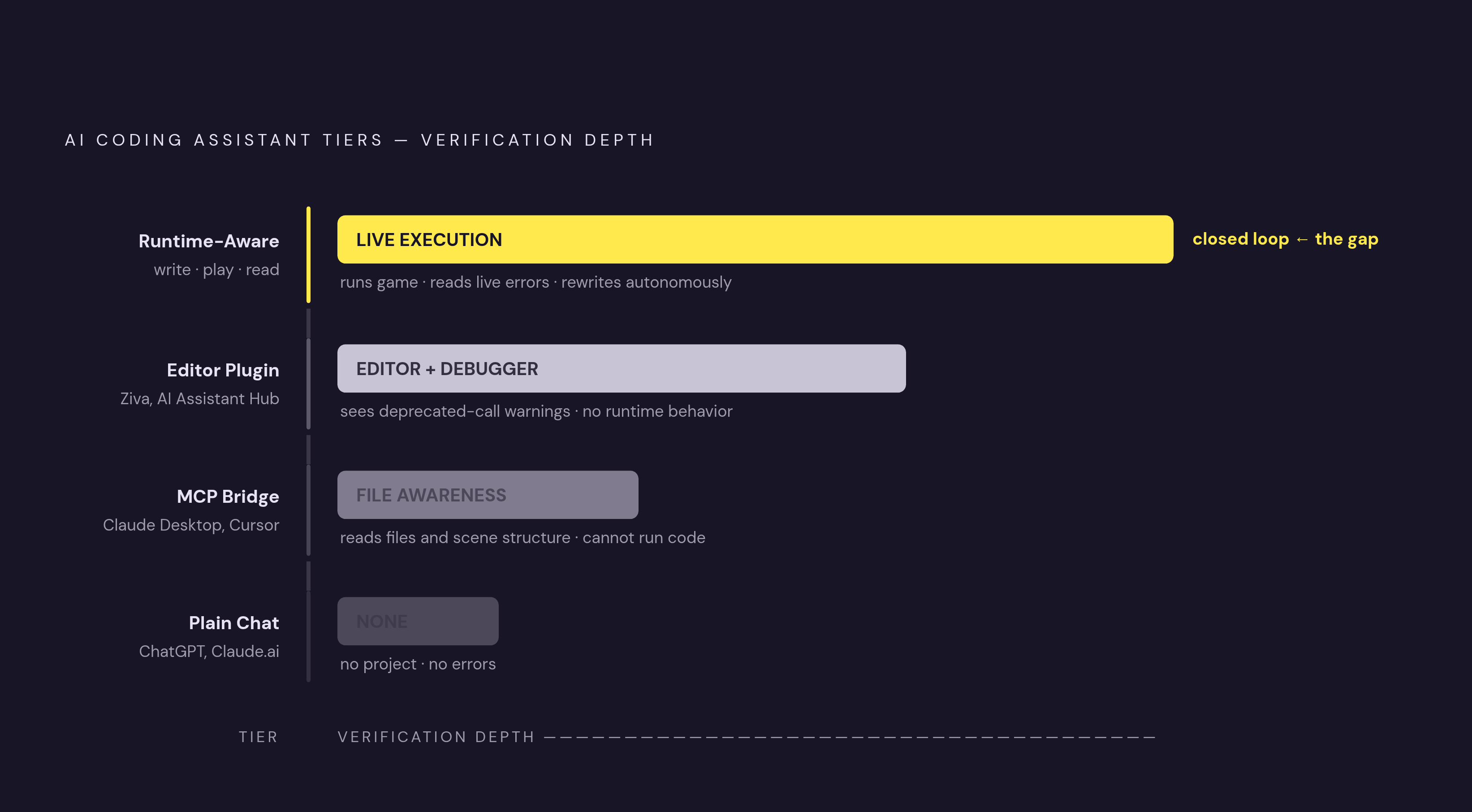
Drift resistance is an architectural property because it depends on what evidence reaches the model after generation. The useful comparison is not feature count but verification depth. Plain chat, MCP bridges, editor plugins, and runtime-aware integrations expose different parts of the project to the assistant. Each tier changes which mistakes the tool can find on its own. That distinction provides a more useful shortlist than treating every GDScript-capable interface as equivalent.
Tier 1 is plain chat, such as ChatGPT and Claude.ai. Its verification level is none because the assistant neither sees the project nor runs the code. It can help with learning GDScript and isolated snippets, but project-wide work requires guesses about node names, scene structure, and signal connections. Drift resistance is absent at this tier. The developer supplies the missing context, integrates the answer, and serves as the test runner.
Tier 2 is an MCP server connecting Claude Desktop or Cursor to Godot through a bridge. Its verification level is file awareness, with the ability to read project files and propose edits. With the real scene files and scripts, the tool no longer has to make up node paths, a big step up from plain chat. Drift resistance remains partial. Runtime API failures still reach the developer because the described integration does not press play and read the live error.
That additional access also changes the risk of a mistake. An MCP agent with write access can refactor several scripts confidently while deleting code the project needs. For teams using this tier, version control and pre-session commits are necessary safeguards.
Tier 3 is an editor plugin, including Ziva and AI Assistant Hub. Its verification level includes access to editor and debugger errors and the ability to edit the scene tree. Editor-flagged deprecated calls become visible to the assistant, allowing it to respond to evidence that plain chat cannot see. Drift resistance is meaningful but inherited from the editor’s reports. The connected model still writes the code and still has its Godot 3 bias.
The plugin options also serve different preferences. AI Assistant Hub is free and open-source, while Ziva is the most polished in-editor plugin option described here. Neither distinction alone establishes stronger version compatibility. The decisive question remains whether the plugin exposes the relevant failure and lets the assistant act on it. Being inside the editor improves grounding without automatically completing runtime verification.
Tier 4 is runtime-aware architecture. Its verification level is an active write-play-read loop in which the assistant runs the game, reads live errors, and rewrites code based on observed behavior. When a call fails because it is incompatible with the version, the assistant can use the engine’s response for the next edit without the developer having to pass it along by hand.
A larger context window does not create that loop. Retrieval-augmented generation against Godot’s documentation can provide current API information, while a purpose-built integration can run code and test its output. Blured Engine describes itself as a community project built on modified Godot 4.x with a built-in OpenCode AI server for natural-language game building.
Why model choice matters less than the feedback loop
Claude Opus is the strongest GDScript choice described here for clean, idiomatic Godot 4 code and the least drift into Godot 3 patterns. That edge matters more in longer scripts, where one out-of-date API call can break the result. GPT offers a faster first response and close GDScript quality on everyday tasks, while trailing on long agentic chains. These advantages improve generation while leaving verification necessary.
DeepSeek is the budget option for usable GDScript, but complex multi-file tasks require more correction passes. It is also text-only, so it cannot inspect the game visually to diagnose a visual bug. For local or offline work, Qwen3-Coder is the strongest option described at its size class, with reasonable Godot 4 syntax and stronger multi-step instruction following than other local models of that size.
Prompt engineering is a useful partial mitigation. Naming the exact version, pasting the scene tree, and explicitly prohibiting KinematicBody2D reduce Godot 3 leakage by marking the deprecated identifier for avoidance during generation. Developers must already know which patterns are obsolete, and their prompt cannot anticipate a minor-release change they have not catalogued. A mid-tier model inside a runtime-aware architecture can therefore produce more correct GDScript than a top-ranked model working blind, because the loop catches errors that stronger generation alone does not.
What to look for when evaluating a Godot AI copilot for drift resistance
The first criterion is exact-version awareness. A tool that cannot read the editor’s version cannot reliably filter suggestions to that version’s API surface. The NPGameDev MCP Toolkit’s version-gating model provides the relevant design pattern by filtering tools from the available surface to prevent cryptic failures. Version compatibility should be explicit. This is the threshold for considering an assistant as more than a source of plausible code.
The second criterion is access to the actual scene tree and node structure. Reading those details gets rid of errors from guessed node names that can slip through in scripts that look right. The third criterion is access to runtime errors in addition to editor output. These checks are related but not interchangeable. Project context establishes what the code refers to, while runtime feedback reveals failures that become visible only when it executes.
The fourth criterion is ownership of the correction loop. An assistant that requires the developer to run the game, interpret the error, and paste context back still delegates a central part of verification. That burden falls particularly heavily on the creators least equipped to diagnose drift. Does the tool close the write-play-read loop itself, or just offer another answer after the developer has tracked down the failure?
The fifth criterion is whether the resulting game is owned, exportable, and publishable. A browser-locked demo does not meet the output standard of a shippable project on Steam, itch.io, or mobile. Version-aware generation and runtime correction are valuable because they support that finished result. The best fit for Godot 4 development is the tool that turns current-version knowledge into verified project changes without making the developer its permanent debugging intermediary.
Sources
- The Best AI Coding Assistant for Godot in 2026 (Ranked by Real GDScript Work)
- The Best AI for GDScript in 2026 (Honest Model and Tool Roundup)
- The Best AI for Godot Game Development in 2026 (Honest Roundup)
- Does Godot Have AI? An Honest Answer (2026)
- Godot AI Assistant Hub: What It Does and the Best Alternatives in 2026
- The Best LLM for GDScript in 2026 (Hosted and Local, Ranked)